

 CampingYour First Camping Trip: A No-Stress ChecklistTent, sleep system, kitchen and a backup plan.
Read next
CampingYour First Camping Trip: A No-Stress ChecklistTent, sleep system, kitchen and a backup plan. CampingKayaking for Beginners: Calm Water FirstPaddle basics, life jackets and picking the right day.
 CampingRock Climbing: How to Start SafelyGyms, guides and the knots you must know.
 CampingHammock Camping: Sleep Among the TreesStraps, bug nets and the diagonal lie.
 ClimbingClimbing Gyms: A Guide to Your First VisitShoes, chalk and bouldering grades.
 CampingWinter Camping BasicsStay dry, eat often and bring a warm water bottle.
 CampingCampfire Cooking: Five Easy MealsFoil packets, skillet breakfasts and s’mores, upgraded.
 CampingCanoe Camping: Paddle In, Camp OutPacking, portages and calm-water routes.
 HikingLayering for Cold-Weather HikesBase, mid, shell — and no cotton.
There is a moment, about half an hour after the campfire burns down, when the sky seems to change. The few bright stars you noticed at dusk are suddenly surrounded by thousands more, and a pale band of light stretches from one horizon to the other. Campsites far from city lights are perfect for stargazing, and you do not need a telescope or a science degree to enjoy them. You need a dark spot, a little patience and a sense of what to look for. Here is our field guide to the night sky from your camp chair.
Find a truly dark site
Light pollution is the biggest obstacle between you and a great night sky. The glow from a city can wash out faint stars for dozens of miles, which is why the best stargazing in the country happens in remote national parks, high deserts and mountain campgrounds. Places like Great Basin, Big Bend and Capitol Reef are famous for their dark skies, but plenty of state parks and national forest campsites are nearly as good.

When you pick a site, look for an open view of the sky, ideally with a low horizon in at least one direction. A campsite tucked deep under tall pines is cozy but leaves you looking at a small patch of stars. A short walk to a meadow, a lakeshore or a rocky overlook can make all the difference.
The phase of the moon matters just as much. A bright full moon lights up the landscape and hides all but the brightest stars. For the darkest skies, plan your trip within a few days of the new moon, or wait until the moon sets later in the night.
Let your eyes adjust
Give your eyes 20 minutes and use a red light. Human eyes take time to adapt to darkness, and the change is dramatic. In the first few minutes you will see only the brightest stars. After 20 minutes or so, fainter stars appear, and the Milky Way starts to show its texture. A single glance at a bright phone screen or a white headlamp resets much of that progress.
Turn off the headlamp. The show is overhead.
Our outdoors editor
Red light preserves your night vision far better than white light. Many headlamps have a red mode, and you can cover a regular flashlight with red cellophane in a pinch. Ask your campmates to switch to red, too, and set your phone to its darkest night mode. It sounds fussy, but the difference is obvious within minutes.
Comfort makes stargazing last longer. Bring a reclining camp chair or a sleeping pad to lie on, a warm jacket even in summer, and a thermos of something hot. Desert and mountain nights cool off quickly once the sun goes down.
What to look for tonight
The Milky Way
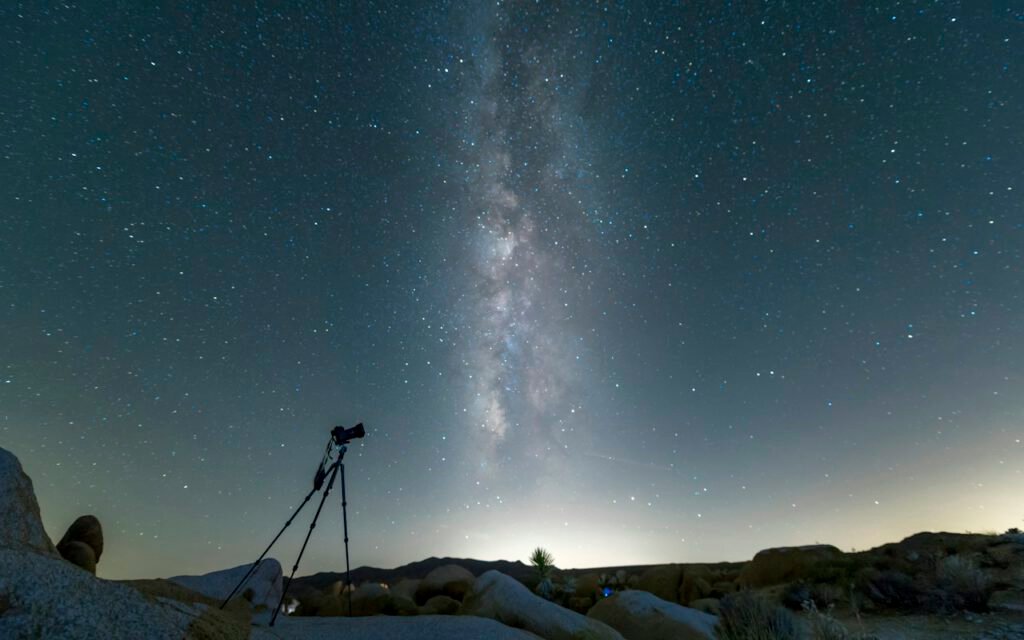
From a dark site, the Milky Way looks like a soft, glowing river of light with dark lanes running through it. In the Northern Hemisphere, its brightest core is best seen in summer, low in the southern sky toward the constellations Sagittarius and Scorpius. In winter, a fainter section arcs overhead near Orion.
Planets
Planets are easy to spot once you know the trick: they generally shine with a steady light, while stars tend to twinkle. Venus is often the brightest object in the evening or morning sky after the moon. Jupiter is bright and creamy white, Mars has a distinct orange tint and Saturn looks like a steady golden star. Even a basic pair of binoculars can reveal Jupiter’s largest moons as tiny points of light lined up beside the planet.
Constellations and bright stars
Start with the easy ones. The Big Dipper is visible year-round from most of the US, and its two end stars point toward Polaris, the North Star. In summer, look for the Summer Triangle, three bright stars high overhead. In winter, Orion’s belt is unmistakable. Learning just a handful of patterns gives you landmarks to find everything else.
Satellites and meteors
Watch for a steady point of light moving slowly across the sky without blinking. That is likely a satellite, and on a clear night you may spot several in an hour. Meteors, often called shooting stars, are quick streaks that last a second or less. You can see a few on almost any dark night.
Plan around meteor showers
Meteor showers turn a good night into an unforgettable one. They happen when Earth passes through debris left by comets, and they arrive around the same dates every year. A few to circle on your calendar:
- Perseids peak in mid-August, often the most popular shower thanks to warm summer nights.
- Geminids peak in mid-December and can be one of the strongest showers of the year, if you can handle the cold.
- Quadrantids peak in early January with a short, sharp burst of activity.
- Orionids peak in late October and are linked to a famous comet.
- Lyrids peak in late April, a nice option for spring campers.
For the best show, watch after midnight, when your side of Earth faces into the stream of debris. Lie back, take in as much of the sky as you can, and be patient. Meteors often come in clusters with quiet gaps in between. Check the moon phase for the peak night, since a bright moon can hide all but the brightest streaks.
Key takeaway: Pick a dark site, aim for a new moon and give your eyes time. Those three steps matter more than any piece of equipment.
Use an app
Sky-map apps help identify planets and constellations. Hold your phone up to the sky and the app overlays labels for stars, planets and constellations in real time. They are excellent teaching tools, especially for kids, and many work offline once you download the star data. Do that before you leave home, since many dark-sky campsites have no cell signal.
Just remember to switch the app to its red night mode and dim the screen as low as it will go. Use it to confirm what you are seeing, then put it away and let your eyes do the rest. A simple paper star chart or planisphere is a great backup that never needs a charge.
If you catch the bug, a pair of 7×50 or 10×50 binoculars is the best next step. They are portable, affordable and reveal star clusters, the craters of the moon and the faint smudge of the Andromeda Galaxy on a dark night.
Stargazing with kids
Children often make the best stargazing companions, because everything overhead feels like a discovery. Keep sessions short and fun. Start with the moon and the brightest planet, then play a game of who can spot the first satellite. Tell them the stories behind the constellations, or invite them to make up their own names for star patterns they find. A warm blanket and a cup of cocoa go a long way toward keeping young astronomers happy past bedtime.
If the night is too cold or too late for little ones, try an early evening session instead. Planets and the brightest stars appear soon after sunset, and spotting the first star of the night is a tradition many families keep for years.
A sky worth staying up for
Stargazing is one of the simplest pleasures of camping. There is nothing to set up and nothing to buy beyond a warm layer and a red light. On your next trip, let the fire die down, switch off the headlamps and give the sky twenty quiet minutes. The show has been running overhead the whole time. All you have to do is look up.

Written by
Mira Shah
Mira climbs, coaches beginners and believes in the partner check above all else.
8Articles
2026Writing since


Start the conversation