



 Yoga & MobilityTen Minutes of Yoga for Stiff Desk BodiesA gentle sequence for hips, back and shoulders.
Yoga & Mobility Nora Ellis6 min read
Yoga Poses for Better Balance
Stand taller, wobble less, fall less.
Nora Ellis6 min read

Written by
Nora Ellis
Nora is a registered dietitian who writes about food without rules, guilt or powders.
25Articles
2026Writing since
Balance is a skill, and like any skill it improves with practice. Most of us never think about it until something goes wrong: a missed step on the stairs, a slip on an icy driveway, a wobble while pulling on a pair of jeans. Yet balance quietly supports almost everything we do, from walking across a parking lot to carrying groceries to playing with kids in the backyard. The good news is that you do not need a studio membership or an hour on a mat to get better at it. A few simple yoga poses, a wall and a couple of minutes a day can help you stand taller and wobble less.
This guide walks you through three beginner-friendly poses, explains why your eyes play such a big role in staying upright, and gives you easy ways to fit practice into an ordinary day. Whether you are a runner looking for steadier ankles, a desk worker trying to undo hours of sitting or someone who simply wants to feel more confident on their feet, the approach is the same: start supported, practice often and let the wobbles do their job.
Why balance fades, and how it comes back
Staying upright is a team effort. Your inner ear senses the position of your head, your eyes read the world around you and thousands of tiny sensors in your feet, ankles and joints report back on where your body is in space. Your brain combines all of that information and sends constant small corrections to your muscles. When we spend most of the day sitting, walking on flat floors and wearing supportive shoes, that system gets less practice, and like any unused skill it can get rusty.
Balance training gives the system something to work on. Each time you stand on one leg and feel your ankle shift, your body is learning to respond a little faster and a little more precisely. Many people notice a difference within a few weeks of regular practice, and the benefits tend to show up in daily life long before they show up on the mat.

Start near a wall
Tree pose, warrior three and chair pose can all be practiced with a hand on the wall. That small bit of support is not cheating. It lets you hold the shape long enough to build strength and awareness, and it removes the fear of falling that makes so many beginners tense up. As you get steadier, you can lighten the touch to one fingertip, then hover your hand an inch away, and finally let go.
Tree pose
Stand tall beside a wall with one hand resting on it. Shift your weight into the foot closest to the wall. Lift the other foot and place the sole against your inner ankle, calf or inner thigh, avoiding the knee joint itself. Press your foot and leg gently into each other, lengthen through the top of your head and breathe. Keep your standing knee soft rather than locked.
Warrior three
Face the wall and place both hands on it at about hip height. Step back until your arms are straight and your body forms an upside-down L. Shift onto one leg and slowly lift the other leg behind you, keeping your hips level and your toes pointing down. Your body and lifted leg should form a long line. This pose is a strong challenge for the hips, the back of the legs and the core.
Chair pose
Stand with your feet together or hip-width apart and a hand on the wall for support. Bend your knees and sit your hips back as if lowering onto a chair, keeping your weight in your heels. Raise your free arm overhead. Chair pose builds the leg strength that steadies every other balance pose, and once it feels easy you can try lifting your heels for a few breaths.
Wobbling is not failing. Wobbling is your balance learning.
Lila Chen, yoga teacher
Yoga teacher Lila Chen tells her beginner classes that the shaking ankle and the swaying arms are exactly what they came for. Each wobble is a correction, and each correction teaches your body to respond. The goal is not to stand perfectly still like a statue. It is to stay calm and keep breathing while your body figures it out.
Fix your gaze
Looking at one still point makes balancing much easier. In yoga this point is often called a drishti, and you can choose anything that does not move: a spot on the wall, a doorknob, a picture frame or a mark on the floor a few feet ahead of you. Keep your eyes soft and steady on that point and avoid glancing around the room.
Try a quick experiment. Stand in tree pose and look at your focus point for a few breaths. Then slowly let your eyes wander around the room. Most people feel the difference right away. Because your eyes are such an important part of your balance system, a steady gaze calms the whole body. Later, as you get stronger, you can deliberately challenge that system by looking up at the ceiling, turning your head slowly or closing your eyes.
Make it a daily habit
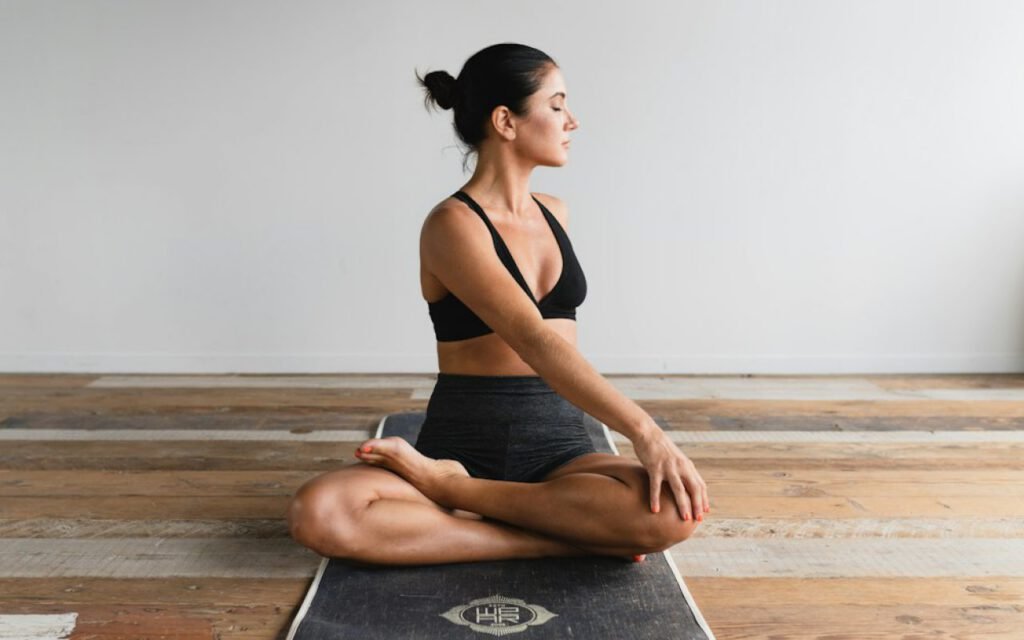
Balance responds best to frequent, short practice rather than occasional long sessions. That makes it one of the easiest skills to weave into your normal routine. You already stand still several times a day while waiting for something. Those minutes can become practice time with almost no extra effort.
- Practice while brushing your teeth
- Hold each pose for 20–30 seconds
- Try with eyes closed only when steady
Brushing your teeth is a perfect moment: two minutes, twice a day, standing at a sturdy counter you can grab if you need to. Stand on one foot for the first minute and switch for the second. You can also practice while waiting for the coffee to brew, while the microwave runs or while talking on the phone. Hold each pose for 20 to 30 seconds and repeat on both sides. Once you can hold a pose comfortably for 30 seconds with your eyes open and without touching the wall, try closing your eyes for a few seconds at a time, always with support close by.
Key takeaway: A few minutes of balance practice every day will do more than one long session a week. Keep a wall nearby, pick a still point to look at and let yourself wobble.
Practice safely
Set up in a clear space on a non-slip surface, ideally barefoot or in flat shoes with good grip. Keep a wall, counter or sturdy chair within reach, and move slowly in and out of each pose. If you feel dizzy, lightheaded or unsteady in a way that worries you, stop and rest. Anyone who has had recent falls, frequent dizziness, an inner ear condition or a joint injury should talk to a doctor or physical therapist before starting, since they can suggest the safest place to begin.
Stand a little taller
Better balance rarely arrives all at once. It shows up quietly: a step taken with more confidence, a curb you no longer think about, a pair of socks pulled on while standing. Start near a wall, fix your gaze, breathe through the wobbles and practice a little every day. If you use the Stride five-moves stepper, add tree pose to the routine and track how your hold time grows over the coming weeks. You may be surprised how quickly your body learns.
General information, not medical advice. Check with your doctor before starting a new exercise or nutrition plan, especially if you have a health condition.
Written by
Nora Ellis
Nora is a registered dietitian who writes about food without rules, guilt or powders.
25Articles
2026Writing since
Read next
Yoga & MobilityTen Minutes of Yoga for Stiff Desk BodiesA gentle sequence for hips, back and shoulders. Yoga & MobilityMobility vs. Flexibility: What’s the Difference?Why being able to control a range matters more than reaching it.
 Yoga & MobilityGentle Yoga for Stress ReliefChild’s pose, legs up the wall and slow breathing.
 Yoga & MobilityBox Breathing: A Calm-Down Tool You Can Use AnywhereInhale four, hold four, exhale four, hold four.
Start the conversation