A Calm Kitchen: How I Finally Organized Mine
Clear counters, a coffee corner and one drawer for everything weird.
 Jess Carter6 min read

Jess Carter
Jess writes about budget home makeovers, thrifted style and slow weekends around Texas.


Our kitchen is small and used to be chaos. Now the counters stay mostly clear — and I actually enjoy cooking. For years, every flat surface held something: a toaster we used twice a month, a pile of mail, a fruit bowl overflowing with chargers, three different cutting boards and a stand mixer I didn’t have room to put away. Making dinner meant shuffling things from one spot to another just to find space to chop an onion. Here’s the system, start to finish. It took two weekends, about $90 and a lot of honest conversations with myself about how many mugs one family needs.
Start with a full empty-out
I know. It sounds exhausting. But the only way I could really see what we had was to take everything out of every cabinet and drawer. I did it one zone at a time over two Saturdays, starting with the worst offender: the cabinet under the sink. I laid everything out on the dining table and sorted it into four piles: keep, donate, toss and belongs somewhere else.
 Sponsored · Cozy Corner HomeThrows, pillows and soft lightsFree shipping over $50.Shop home
The results were humbling. I found three vegetable peelers, four cans of the same chickpeas, two broken spatulas and a waffle iron we hadn’t used since our son was a baby. We had nineteen mugs. Nineteen. For a family of four. After the sort, we kept eight, donated two full boxes of duplicates and cleared out a surprising amount of space.
Questions I asked about every item
- Have I used this in the past year?
- Do I have another one that does the same job?
- Would I buy this again today?
- Is it worth the space it takes up?
If the answer to most of those questions was no, the item went into the donate box. I made exceptions for sentimental things, like my grandmother’s rolling pin and a chipped bowl my daughter painted in kindergarten. Those stayed.
Zones, not rooms
Coffee things in one corner, baking in one cabinet, snacks at kid height. This was the biggest shift in how I think about kitchen organization. Instead of putting things wherever they fit, I organized our kitchen around activities. Each zone holds everything needed for one task, right where that task happens.
Here’s how our kitchen is zoned now:
- Coffee corner: The coffee maker, mugs, beans, filters and sugar, all in one spot by the window.
- Prep zone: Knives, cutting boards, mixing bowls and measuring cups between the sink and the stove.
- Cooking zone: Pots, pans, spatulas, oils and spices right next to the stove.
- Baking cabinet: Flour, sugar, baking soda, sheet pans and cookie cutters together.
- Kid snack drawer: Healthy snacks, cups and plates at kid height so they can help themselves.
- Cleanup zone: Dish soap, towels, trash bags and the compost bin under and around the sink.
The zone system means I’m not running back and forth across the kitchen while cooking. Everything I need is within arm’s reach. And because everything has a clear home, it’s easy for the whole family to put things back where they belong.
The coffee corner
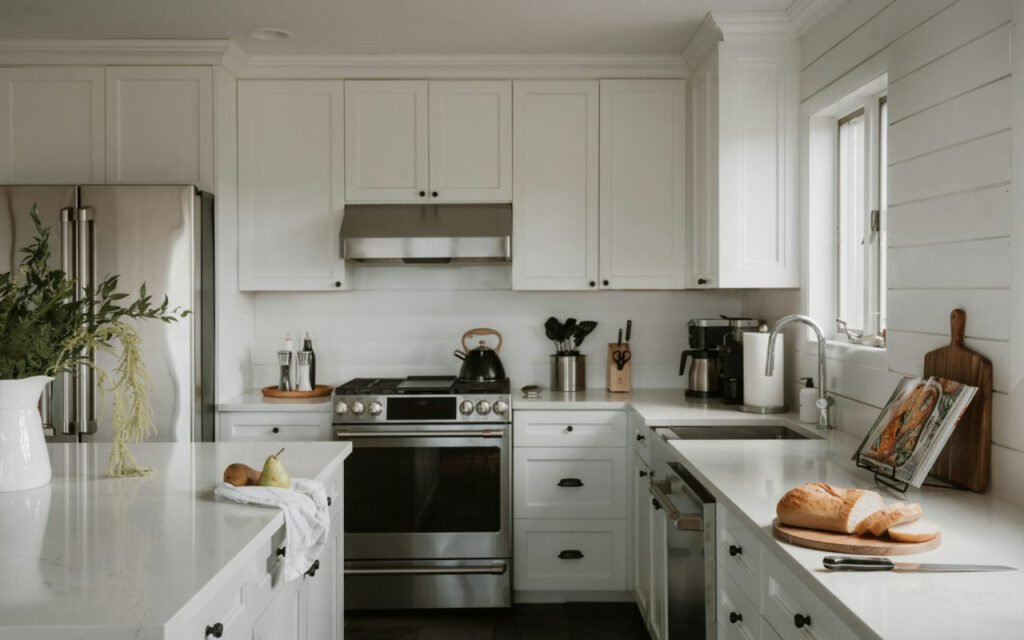
The coffee corner deserves its own section, because it’s the part of the kitchen that brings me the most joy every morning. It sits on a short stretch of counter near the window. A small wooden tray holds the coffee maker, a canister of beans, a grinder and a little jar of sugar. Mugs hang from hooks on the wall above, and a narrow shelf holds tea, honey and a few cookbooks.
Corralling everything onto a tray makes the counter look neat even when it’s full. It also makes cleaning easier, since I can lift the whole tray to wipe underneath. My husband now makes our coffee every morning without asking where anything is, which honestly might be the biggest win of the whole project.
Organizing isn’t about perfect. It’s about finding the scissors on the first try.
Jess
Clear counters, simple tools
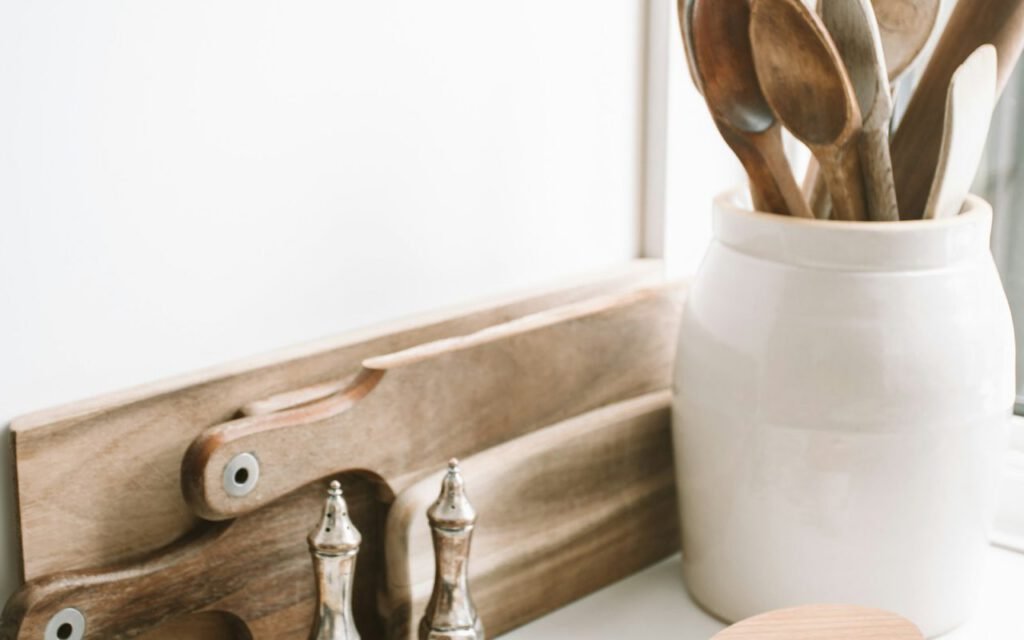
The secret to clear counters is deciding exactly what earns a permanent spot. In our kitchen, only four things live on the counter: the coffee tray, a crock of wooden spoons and spatulas by the stove, a knife block and a small cutting board. Everything else gets put away after use.
The toaster moved to a lower cabinet. The stand mixer went to the pantry shelf. The mail now goes to a small basket by the front door, not the kitchen counter. These were small changes, but together they cleared nearly half of my counter space.
A few inexpensive tools made the biggest difference:
- Drawer dividers: Bamboo dividers keep utensils from becoming a tangled mess.
- Shelf risers: Double the usable space in cabinets for plates and bowls.
- Clear bins: In the pantry and fridge, so we can see what we have.
- A lazy Susan: For oils, vinegars and spices in the corner cabinet.
- Labels: Simple handwritten labels on pantry jars and bins.
Key takeaway: If something doesn’t get used at least a few times a week, it doesn’t need to live on the counter.
The weird drawer
Every kitchen needs one drawer for batteries, rubber bands and mystery keys. Embrace it. I used to feel guilty about our junk drawer. It seemed like proof that I hadn’t really gotten organized. But here’s the truth: every household has a pile of small, odd items that don’t belong anywhere else. Pretending they don’t exist just means they end up scattered across the counter.
So I gave the weird drawer a makeover instead of trying to get rid of it. I added a small drawer organizer with compartments, and now everything has a little home. Batteries in one section. Rubber bands and twist ties in another. Scissors, tape and a pen in the front. Mystery keys get their own small cup, and once a year, I test them and toss the ones that don’t open anything we own.
The pantry and fridge
Our pantry is just a tall cabinet, so every shelf has a job. The top shelf holds backup supplies and holiday platters. The middle shelves hold grains, pasta, canned goods and breakfast foods in clear bins with handwritten labels. The bottom shelf is for heavy things like potatoes, onions and the stand mixer. In the fridge, I use a few clear bins to group leftovers, snacks and sandwich supplies, and I keep a small “eat this first” bin at eye level for anything that needs to be used soon. It has cut our food waste noticeably, and it makes packing school lunches so much faster.
Keeping it calm
Getting organized is the easy part. Staying organized takes a few simple habits. Every night after dinner, we do a ten-minute kitchen reset. Dishes go in the dishwasher, counters get wiped and anything that’s out of place goes back to its zone. Once a week, I do a quick fridge clean-out before the grocery run. And every few months, I spend half an hour going through one zone to see what’s crept back in.
Our kitchen isn’t perfect. There’s still a pile of art projects on the fridge, a bowl of lemons that’s often a bowl of lemons and a toy dinosaur, and the weird drawer is, well, weird. But it’s calm. I can find what I need, cook without frustration and actually enjoy being in the room. If your kitchen feels chaotic, start with one drawer this weekend. You’ll be amazed how good it feels to find the scissors on the first try.
Jess Carter
Jess writes about budget home makeovers, thrifted style and slow weekends around Texas.


2 Comments
Thanks for explaining this so clearly.
Great reporting — please keep following this story.