

Daniel Stone
Daniel leads cultural and workplace projects.



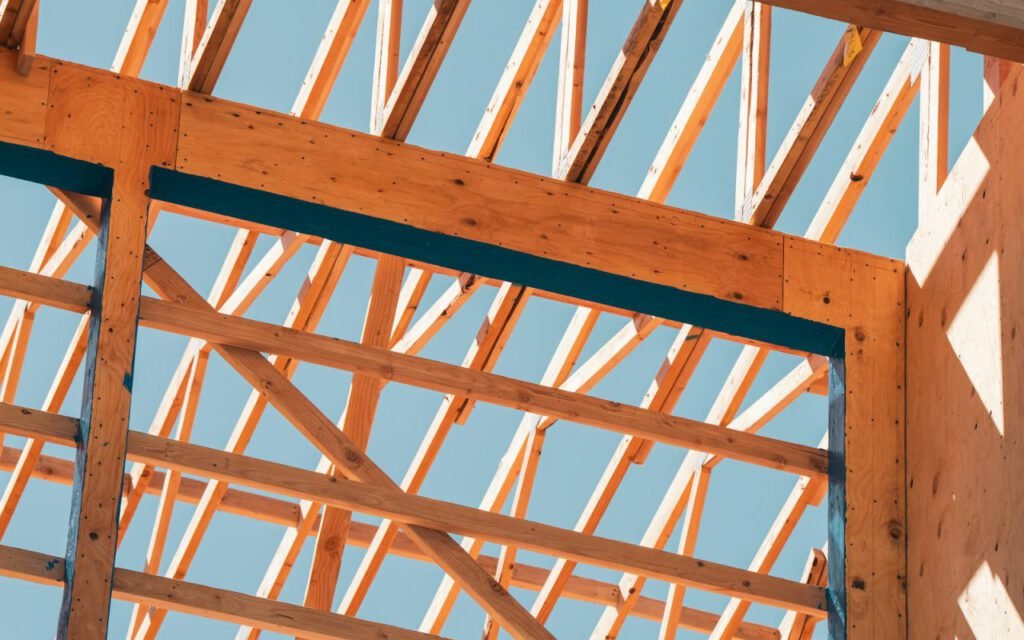
More of our projects now use mass timber — engineered wood strong enough for multi-story buildings. Five years ago, it appeared in one of our drawings as an experiment. Today, nearly half of the buildings on our boards include a timber structure of some kind, from a two-story library branch to a five-story office building in Portland. It’s warm to touch, quick to build and stores carbon instead of emitting it. In this post, we want to explain why we keep choosing it, where it works best and where we still have questions.
We are often asked whether timber is a trend. We do not think so. Wood is one of the oldest building materials there is, and for most of human history, it was the default. What has changed is the technology. Modern engineered timber panels and beams can span larger distances, carry heavier loads and meet stricter safety standards than traditional lumber, which opens up building types that used to belong almost entirely to steel and concrete.
What mass timber actually is
Mass timber is a family of engineered wood products made by bonding smaller pieces of wood together into large, strong structural elements. The most common types we use are:
- Cross-laminated timber (CLT): layers of lumber stacked at right angles and glued under pressure into large panels, used for floors, walls and roofs.
- Glued laminated timber (glulam): layers of lumber glued together along their length to form beams and columns, often in long or curved shapes.
- Nail-laminated timber (NLT): lumber boards placed on edge and nailed together, a simpler system often used for floors and roof decks.
Because these products are manufactured in a controlled factory, they are consistent, precise and strong. Panels are cut to exact dimensions using computer-controlled machines, with openings for windows, doors and mechanical systems already in place before they arrive on site.
Faster on site
Panels arrive ready to install, so buildings go up in weeks, not months. On our recent community center project in Boise, the timber structure for the main hall, including floors, walls and roof, was assembled in just under four weeks by a crew of six. A comparable concrete frame would likely have taken several months, with more workers on site and much more noise for the surrounding neighborhood.

Speed matters for more than the schedule. A shorter construction period can reduce costs for the client, limit disruption for neighbors and lower the risk of weather damage during the build. Timber panels are also much lighter than concrete, which means smaller foundations and, on some sites, smaller cranes and fewer truck trips.
There are trade-offs. Mass timber requires careful planning early in the design process, because changes become much harder once panels are in production. We now bring structural engineers, manufacturers and builders into conversations much sooner than we would on a conventional project, which takes more coordination up front but tends to pay off later.
Wood is the oldest building material and the most modern.
Elena Hale
Kinder to the planet
The environmental case for timber is one of the main reasons we use it. Trees absorb carbon dioxide as they grow and store that carbon in their wood. When that wood becomes part of a building, the carbon stays locked inside for as long as the building stands. By contrast, making cement and steel requires a great deal of energy and produces significant emissions.
That said, timber is only as sustainable as the forests it comes from. We specify wood from responsibly managed forests that are replanted after harvest, and we ask suppliers to document where their timber was grown. We also try to source from mills within a reasonable distance of each project, which reduces transportation emissions and supports regional economies.
We are careful not to overstate the benefits. The full environmental impact of a building depends on many factors, including how long it lasts, how much energy it uses over its lifetime and what happens to its materials at the end. Timber is not a magic solution, but in many of our projects, it has helped reduce the overall carbon footprint compared with an all-concrete or all-steel design.
Better to live in
People feel calmer in rooms with natural materials. We see it every time. When we leave the timber structure exposed, as we often do, rooms take on a warmth and texture that is hard to achieve with painted drywall or polished concrete. Visitors touch the columns as they walk past. Children run their hands along the wood walls.

Wood also has practical comfort benefits. It is a better insulator than steel or concrete, which can help with thermal comfort, and its surface absorbs some sound, which can make large rooms feel quieter. In our workplace projects, clients have told us that employees describe timber offices as more relaxing and welcoming, and several have reported that people simply want to spend more time there.
Timber is also forgiving to work with during the life of a building. Interior walls can be moved, openings can be cut and new connections can be added with ordinary tools, which makes future renovations simpler. And when a timber building eventually reaches the end of its useful life, many of its beams and panels can be carefully taken apart and reused rather than crushed and hauled away. We now design key connections with that possibility in mind.
A note on fire and moisture
The two questions we hear most often about timber are about fire and water. Mass timber behaves differently from light wood framing in a fire. Large timber elements tend to char on the outside, and that charred layer helps protect the wood inside, which is part of why building codes in many places now permit taller timber buildings than in the past. Every project we design meets local code requirements and is reviewed by fire safety professionals.
Moisture is a more ordinary concern, but an important one. Timber must be protected from long-term exposure to water during construction and over the life of the building. We design generous roof overhangs, careful flashing and good ventilation, and we work with builders to keep panels covered and dry on site.
Where we go from here
Timber will not be right for every project. Some sites, budgets and building types are still better suited to steel or concrete, and many of our designs combine materials, using concrete for foundations and cores and timber for floors and frames. The goal is always the best building for the place and the people who will use it, not loyalty to a single material.
But we expect timber to play an even larger role in our work in the years ahead. Manufacturing capacity is growing, codes are evolving and more builders are gaining experience with these systems. We are currently designing our first timber housing project, a small group of townhomes, and we look forward to sharing it once construction begins.
If you are considering a new building and want to know whether mass timber could work for you, we would be happy to talk it through. Every project starts with a conversation about the site, the budget and the kind of place you want to create.
Key takeaway: Mass timber lets us build faster, store carbon instead of emitting it and create warmer, calmer spaces, as long as it is sourced responsibly and designed with care from day one.
Daniel Stone
Daniel leads cultural and workplace projects.

Start the conversation