

 Home & LivingHow to Make a Small Apartment Feel Twice as BigMirrors, legs on furniture and one rug instead of three: designers share the tricks that actually…
Home & Living Owen Marsh6 min read
Smart Storage Ideas for Tiny Kitchens
Walls, doors and the space above the cabinets.
Owen Marsh6 min read

Written by
Owen Marsh
Owen writes long features and the monthly book column.
6Articles
2026Writing since
Small kitchens have more storage than you think. When we moved into a 1920s bungalow with a galley kitchen barely wider than a hallway, I counted exactly four drawers and six cabinets. For the first month, the counters disappeared under jars, pans and a toaster that had nowhere to live. Then I started looking at the room differently: not as a box with too few cupboards, but as a set of walls, doors and corners that weren’t doing their share.
The good news is that most tiny kitchen fixes are inexpensive, renter-friendly and quick to install. You don’t need a remodel to find room for the things you cook with every day. You need a plan, a tape measure and a willingness to put a few things on display. Here’s how to find the hidden storage in your own kitchen, from the floor to the space above the cabinets.
Advertisement Sponsored · Fernhill BooksIndependent since 1974Free shipping on orders over $35.Shop books
Sponsored · Fernhill BooksIndependent since 1974Free shipping on orders over $35.Shop booksStart with an honest edit
Before buying a single hook or bin, empty one cabinet at a time and sort what you find. Most of us keep duplicates we never use: three colanders, a drawer full of takeout chopsticks, a bread machine from a holiday years ago. In a small kitchen, every item has to earn its spot.
A simple way to decide is to sort items into three groups:
- Daily: Things you reach for most days, like your favorite skillet, a cutting board and a chef’s knife. These get the easiest-to-reach places.
- Weekly or seasonal: Roasting pans, the stand mixer, holiday platters. These can go higher, lower or in a nearby closet.
- Rarely: Anything you haven’t touched in a year. Donate it, sell it or store it outside the kitchen.
Once the clutter is gone, you’ll see the real shape of your storage problem, and it’s almost always smaller than it looked.
Use the walls
Rails and magnetic strips free up drawers. A single stainless rail mounted under the upper cabinets or along the backsplash can hold utensils in hanging cups, a roll of paper towels, mugs on S-hooks and even small herb pots. Rails come in many lengths, and you can add hooks and baskets as your needs change.
AdvertisementSponsored · Fernhill BooksIndependent since 1974Free shipping on orders over $35.Shop books
Sponsored · Fernhill BooksIndependent since 1974Free shipping on orders over $35.Shop books
A magnetic knife strip is one of the best small-kitchen upgrades you can make. It clears the bulky knife block off the counter, keeps blades sharp because they aren’t knocking together in a drawer and puts your most-used tools right where you need them. Mount it out of reach of small children and away from the stove.
Every empty wall is a shelf waiting to happen.
Professional organizer (fictional)
Open shelves are another option for a blank wall. Two or three simple floating shelves can hold everyday dishes, glasses and pretty jars of pasta and rice. Keep them for items you use often so dust doesn’t have time to settle. If you rent, look for freestanding wall-leaning shelves or ask your landlord before drilling; many will say yes to a small, neat improvement.
Pegboard is not just for garages
A painted pegboard panel on the end of a cabinet run or beside the fridge turns into a flexible wall for pots, lids, measuring cups and even cutting boards. Paint it the same color as the wall for a quiet look, or pick a cheerful shade to make it a feature.
Inside cabinet doors
Hooks and racks hold lids and wraps. The back of a cabinet door is one of the most overlooked surfaces in any kitchen, and it’s often a full two square feet of space. Adhesive or screw-in racks can hold pot lids, rolls of foil and plastic wrap, measuring spoons, oven mitts and spice jars.
Before you buy, measure carefully. Check the depth between the door and the shelf edge when the door is closed, and leave a little room so nothing bumps the shelves. Under the sink, a door-mounted caddy is perfect for sponges, brushes and dish gloves, keeping the cabinet floor free for cleaning supplies.
The inside of a pantry door is even better. An over-the-door rack with several shallow baskets can hold an entire spice collection, snack packs or canned goods, and it lets you see everything at a glance instead of digging through the back of a shelf.
Go up and go under
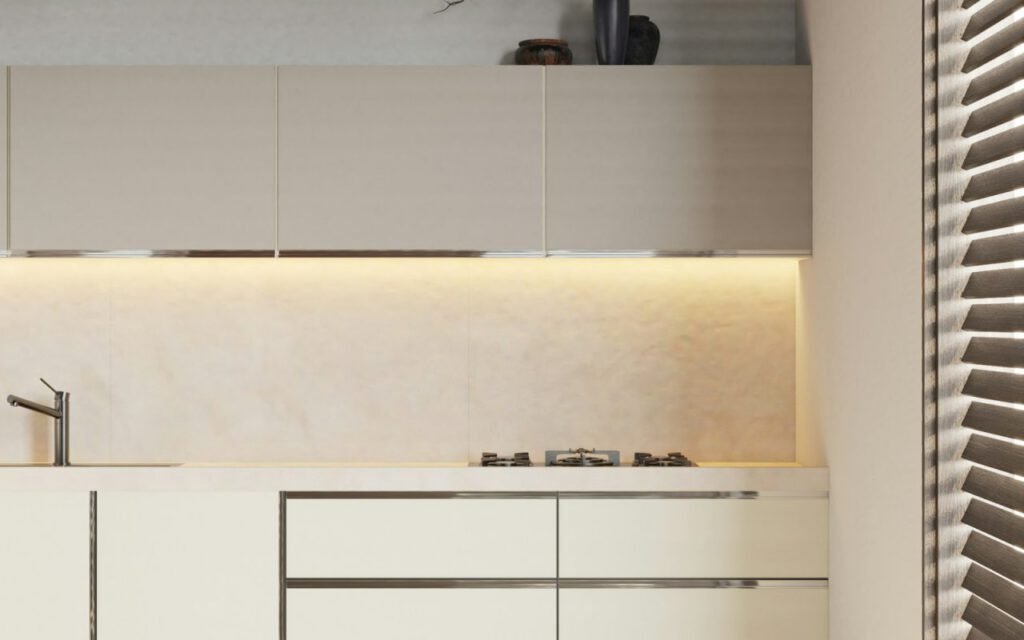
The space above the cabinets is prime real estate in a small kitchen. If there’s a gap between the top of your upper cabinets and the ceiling, use it for items you need only a few times a year. Matching baskets or lidded bins keep it looking tidy and protect things from dust and cooking grease. Keep a sturdy step stool nearby so you never have to climb on a counter.
Inside the cabinets, vertical space usually goes to waste. A plate stacked on a plate leaves several inches of empty air above it. Add these simple helpers:
- Wire shelf risers to create a second level for mugs, bowls or cans
- Vertical dividers to store baking sheets, trays and cutting boards on their edges
- Stackable clear bins for small packets and loose items
- Turntables in deep corner cabinets so nothing gets lost in the back
- Under-shelf baskets that slide onto an existing shelf and hang below it
Down low, consider the space under the sink and the narrow gaps beside the fridge or stove. A slim rolling cart, often just six inches wide, can slide into those gaps and hold oils, vinegars and spices. Under the sink, a two-tier sliding organizer that fits around the pipes doubles the usable space.
Make the counters work harder
Clear counters make a small kitchen feel bigger, but you still need a few things close at hand. Group daily items on a tray: oil, salt, pepper and a crock of wooden spoons. A tray turns scattered objects into one tidy zone, and you can lift it to wipe underneath.
Think about which appliances truly deserve counter space. If you make coffee every morning, the coffee maker stays. If the blender comes out once a week, it can live in a cabinet. A rolling kitchen cart or a small butcher-block island on casters adds prep space when you need it and tucks away when you don’t.
Light and labels help too
Small kitchens often have one overhead fixture and dark corners where things get lost. Battery-powered, stick-on LED strips under the upper cabinets and inside deep cupboards make it much easier to find what you need, and they make a narrow room feel larger in the evening. Clear containers with simple labels on the front do the same job for the pantry: you can see at a glance when you’re low on oats or rice, which saves you from buying a third bag of something you already own.
Key takeaway: Store by frequency. Daily items at arm’s reach, weekly items a step away and rarely used items up high or out of the kitchen entirely.
Small kitchen, big payoff
It took me one weekend and about $120 in rails, racks and baskets to rescue our galley kitchen. The counters are clear, every pan has a home and I can finally cook dinner without moving a stack of mail first. The room didn’t get any bigger; I just started using every surface it had.
Start with one wall or one cabinet door this week and see how it feels. If you’re planning a bigger refresh, our room-refresh budget estimator can help you price out shelves and organizers before you shop. A tiny kitchen can be one of the hardest-working rooms in your home, and with a little creativity, one of the most pleasant to cook in.
Written by
Owen Marsh
Owen writes long features and the monthly book column.
6Articles
2026Writing since
Read next
Home & LivingHow to Make a Small Apartment Feel Twice as BigMirrors, legs on furniture and one rug instead of three: designers share the tricks that actually… Home & LivingThe Five-Minute Morning Routine Doctors Actually RecommendWater, light, a short walk and two other habits that make a measurable difference by noon.
 Home & LivingInside the Community Garden Feeding 300 FamiliesVolunteers grow 12 tons of vegetables a year on a former parking lot — and give…
 CultureMeet the Potter Making Bowls for America’s Best KitchensFrom a converted barn in Kentucky, one maker throws 3,000 pieces a year — every one…
Start the conversation