 Maya Chen6 min read
Starting a course is easy. Finishing it is the hard part. You sign up on a wave of excitement, watch the welcome video, download the workbook and breeze through the first lesson. The second one goes fine. Then the third lesson lands in a busy week, and you tell yourself you will catch up on Saturday. Saturday turns into next week, next week turns into next month, and the course quietly joins the list of things you meant to finish.
These habits help our students finish at more than twice the industry average. At SkillForge Academy, we pay close attention to where learners drop off and what the ones who finish do differently. The answer is rarely talent or free time. It is structure, a few small routines that make showing up the default instead of a decision. Here is what works.
Why most people stop at lesson three
Early lessons run on novelty. Everything is new, the material is introductory and progress feels fast. Around the third or fourth lesson, two things usually change. The content gets harder, and the excitement fades. At the same time, life keeps happening: work deadlines, family plans, a cold, a trip. With no external structure, the course is the easiest thing to push aside, because nobody notices when you skip it.
That is the real problem. Online learning is flexible, which is a huge advantage, but flexible also means optional. The students who finish do not rely on motivation to carry them through. They build systems that keep them moving even on the days when motivation is low.
Book it like a meeting
Put two 45-minute blocks in your calendar every week and treat them like a meeting with your future self. This is the single most effective habit we see among students who finish. A vague intention to study “when I have time” almost never survives a busy week. A specific, recurring calendar event usually does.
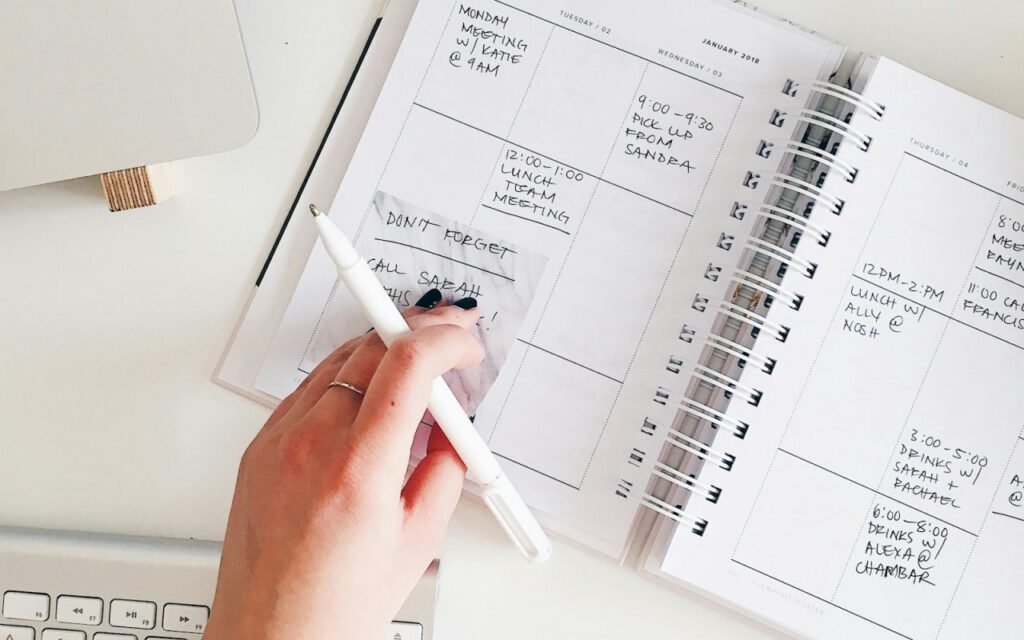
Why 45 minutes? It is long enough to finish a full lesson and its exercise, but short enough to fit before work, during a lunch break or after the kids go to bed. Two blocks a week keep the material fresh without making the course feel like a second job.
Making the blocks stick
- Pick the same days and times each week, such as Tuesday at 7 a.m. and Thursday at 8 p.m.
- Give the event a clear name, like “Course: Lesson 4,” so you know exactly what to do when it starts.
- Protect it the way you would a meeting with your manager. Move it if you must, but never delete it.
- Set up your space in advance: laptop charged, headphones ready, course tab open.
- Silence notifications for the full 45 minutes.
Small, steady sessions beat weekend marathons every time.
Maya, head of learning
Maya leads our learning team, and she has watched plenty of well-meaning students plan a six-hour Saturday catch-up session that never quite happens. Long sessions are tiring and easy to cancel. Short, regular ones build momentum and help you remember more, because your brain gets time to process the material between sessions.
Learn with people
Live sessions and a small study group keep you going when motivation dips. Learning alone on a laptop can feel isolating, and isolation makes it easy to drift away. When other people expect to see you, or when you can ask a real person a question and get an answer, the course becomes something you are part of rather than something you are watching.
Join live sessions
Most SkillForge courses include live workshops, office hours or Q&A sessions with instructors. Even if you cannot attend every one, aim for at least one a month. Hearing other students’ questions often clears up things you did not realize you were confused about, and putting a face to your instructor makes the course feel more personal.
Find a small study group
Three to five people is the sweet spot. Large groups get noisy and easy to ignore, while a pair can fall apart if one person gets busy. A small group can meet for 30 minutes once a week, by video or in person, to share progress, work through a tricky exercise or simply check in.

If you do not know anyone taking the same course, our community forums and course chat channels are full of students looking for partners. Post a short introduction with your time zone and the days you usually study, and you will likely find a match within a few days.
Build while you learn
Watching lessons feels productive, but real learning happens when you use what you learned. The students who finish tend to turn each lesson into something concrete: a small project, a practice file, a design, a working piece of code. Building gives you a reason to come back, because you want to see the project grow.
Choose one project that runs through the whole course. If you are learning web design, design a site for a friend’s small business. If you are learning data skills, analyze a public dataset you care about. If you are learning photography, shoot one theme each week. Every lesson becomes a step toward something you want to finish.

Then share your work each Friday. Post an update in your study group, the course community or even your own social media. It does not need to be polished. A screenshot and two sentences about what you learned is plenty. Sharing creates a small, friendly deadline, and the feedback you get is often more valuable than the lesson itself.
Key takeaway: Motivation fades, but structure lasts. Calendar blocks, people and a real project keep you moving when the excitement wears off.
The finishing plan
Here is the whole system in four steps. Print it out, stick it next to your desk or save it on your phone:
- Two calendar blocks a week
- Join one live session
- Build while you learn
- Share your work each Friday
It also helps to track your progress somewhere you can see it. A simple checklist of lessons taped to the wall, or a progress bar in your course dashboard, gives you a small sense of accomplishment every time you mark something done. Seeing ten lessons checked off makes the remaining five feel very doable, and it reminds you how far you have come on the days when the next lesson feels like a stretch.
If you fall behind, do not try to catch up all at once. Skip ahead to the current lesson, keep your two weekly blocks and go back to the missed material when you have momentum again. Missing a week is normal. Quitting because you missed a week is the trap.
Most people stop at lesson three. Here is how not to.
Finishing an online course is not about having more willpower than everyone else. It is about removing the decision to show up. Book two 45-minute sessions a week, learn alongside other people, build something real and share your progress every Friday. Keep the sessions small and steady rather than saving everything for the weekend.
When you finish, you will have more than a certificate. You will have a project you are proud of, a few new friends who learned with you and the confidence that you can see something through. Open your calendar now and book your first two blocks. Your future self will be glad you kept the appointment.

Maya Chen
Maya has taught design online since 2017.



Maya Chen
Maya has taught design online since 2017.




2 Comments
Thanks for explaining this so clearly.
Great reporting — please keep following this story.