 Pip Moreno6 min read
A picture book takes me about nine months, from first read to final art. People are often surprised by that. The books are short, after all, sometimes only a few hundred words, and you can read one aloud in five minutes. But every one of those 32 pages has to do a lot of work, and getting each spread right takes time, patience and a surprising number of pencils.
Here’s the whole process, step by step. Every publisher and every author is a little different, so think of this as how I work, not a rule book. If you are an aspiring illustrator, I hope it helps you see the shape of the job. If you are an author or editor thinking about working with me, now you know what happens between the manuscript and the finished book.
Reading the manuscript (many times)
The first step sounds simple: I read the manuscript. Then I read it again. By the time I start drawing, I have usually read it at least ten times, out loud, in different moods and at different times of day. Picture books are meant to be read aloud, so I want to hear the rhythm of the words before I decide where the pictures go.
On the first few reads, I do not draw at all. I just make notes in the margin: where the story speeds up, where it slows down, where the reader needs a big surprise, where the text says one thing but the picture could say something more. Those notes become my map.
The words tell half the story. The pictures tell the other half.
Pip
I believe that more with every book. The best picture books leave room for the art to add things the words do not say: a cat hiding on every page, a sibling’s expression that reveals what the main character is really feeling, a small detail in the background that pays off at the end.
Thumbnails first
I sketch all 32 pages as tiny thumbnails to plan the rhythm of the story. Each thumbnail is about the size of a postage stamp, drawn on a single sheet laid out like the actual book: a few single pages at the front for the title and dedication, then spreads that open across two pages.
Thumbnails are where the most important decisions happen. How many spreads does the story need? Where does the big moment land, on the left or the right? Which pages are quiet and which are full of action? A good picture book has a pace, like a song. Close-ups follow wide scenes. A busy page is followed by an empty one. A page turn hides a surprise.
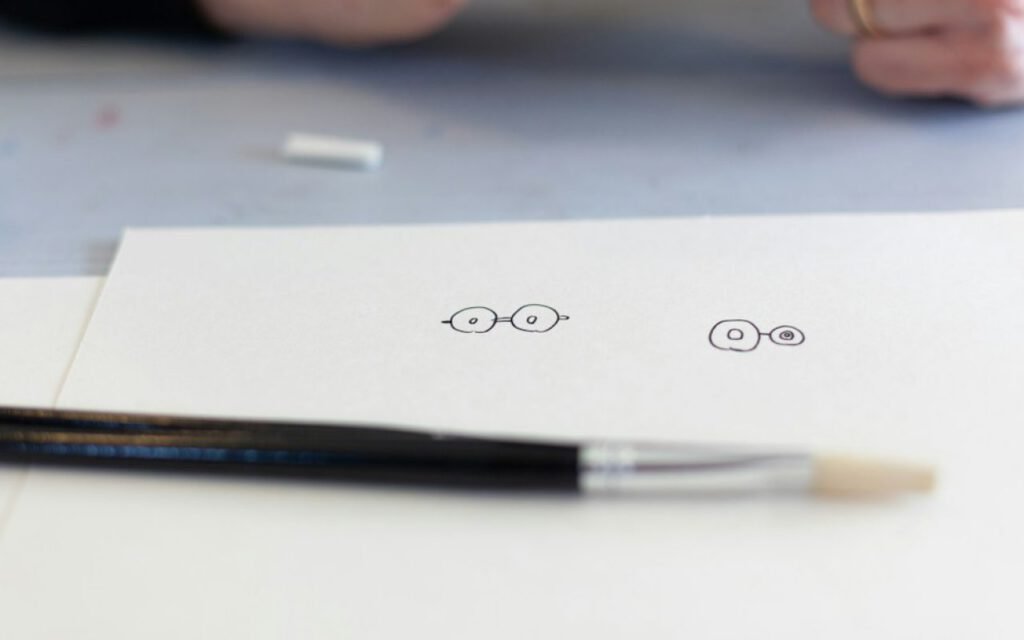
I usually make three or four full rounds of thumbnails before I am happy. Because they are so small, I can throw away a whole version without feeling sad about it. That freedom is the whole point.
Character sheets
Once the rhythm feels right, I design the characters. A character sheet is a page (often many pages) showing the same character from the front, side and back, in different poses and with a range of expressions: happy, worried, sleepy, furious, embarrassed. If a character wears a scarf, I decide exactly how it wraps. If they have a dog, I decide whether its ears flop or stand up.
This step keeps the character consistent across 32 pages, which is harder than it sounds. Over nine months, my hand drifts. A nose gets a little bigger, a head gets a little rounder. The character sheet pinned above my desk keeps me honest.
Finding the right look
I also make small color tests at this stage. I might paint the main character in three different palettes and see which one feels right for the mood of the story. A bedtime book wants softer, cooler colors. A loud, funny book about a runaway goat wants something brighter.
Sketches for approval
Next come the full-size sketches. I redraw every thumbnail at the actual size of the printed book, adding detail, working out perspective and figuring out exactly where the text will sit. Leaving room for words is a big part of the job; nobody wants a sentence printed across a character’s face.
These sketches go to the editor and art director, and usually to the author too. They send back notes. Some notes are small (“can her boots be red?”), and some are bigger (“this spread feels slow; can we see the kitchen from above?”). I revise, send them back and repeat. It is normal to go through two or three rounds.

I also make a rough dummy at this stage: a folded, stapled mock-up of the whole book with the sketches printed at size. Turning real pages, even rough ones, shows me things a screen never does. I can feel whether a page turn lands, whether the text sits comfortably and whether a quiet spread gives the reader enough room to breathe before the next big moment. I read the dummy aloud to my nephew whenever he visits. He is six, and he does not hold back. If he flips ahead or starts asking about snacks, I know a spread needs work.
I used to dread feedback. Now I look forward to it. A good editor sees the book with fresh eyes, and almost every note makes the story clearer for the kids who will read it.
Color last
Only when every sketch is approved do I start the final paintings. This is the longest stage, usually three or four months. I paint in watercolor and gouache, then scan each piece and do small cleanups digitally. Some illustrators work fully digital; others are fully traditional. There is no wrong answer, only what fits the book.
Saving color for last matters because color is slow. If I painted a full spread and then the editor asked to move the character to the other side of the page, I would have to start over. By waiting until every composition is locked, I can paint with confidence and spend my time on light, texture and mood instead of redoing layouts.
A typical painting day
- Morning: transfer the approved sketch to watercolor paper and lay in the first washes
- Midday: let things dry (lunch, walk, a few emails)
- Afternoon: build up shadows and details, then add gouache highlights
- Evening: scan the day’s work and check it against the spread before and after

My steps
Here is the whole process in one place, for anyone who likes a checklist:
- Read the manuscript ten times
- Thumbnail all 32 pages
- Character sheets
- Sketches for approval
- Final color art
After the final art is delivered, the designer places the text, the printer sends proofs and I check the colors one more time. Then, about a year after I first read the manuscript, a box of finished books arrives on my porch. I still get a little teary every time.
Key takeaway: plan small, decide early and save the slow, beautiful part for last.
Why it is worth the wait
Nine months can feel like a long time to spend on 32 pages. But a picture book gets read hundreds of times by the same child, often at bedtime, often by a tired parent. Every page should hold up to that. When a kid finds the hidden cat on page 19 for the first time, or points at a character’s face and says “she’s sad,” I know the slow work was worth it. That is the part I love most, and it is why I keep coming back to this wonderful, patient kind of storytelling.
Pip Moreno
Pip draws picture books, murals and happy little packages.

Pip Moreno
Pip draws picture books, murals and happy little packages.


Start the conversation