

A bedroom has one job: help you rest. Everything else is a distraction. That sounds obvious until you look at most real bedrooms, including, for years, my own. A laptop on the nightstand, a laundry pile on the reading chair, a television mounted where a painting should be and a ceiling light bright enough for surgery. When clients ask me to redesign a bedroom, the first thing we do is take things out. Here’s my checklist for every bedroom project, the same one I use in a New York studio apartment or a farmhouse outside Nashville.
A quick note before we start: design can make a room calmer and more comfortable, but it is not a cure for sleep problems. If you regularly struggle to sleep, talk to your doctor.
Start with the bed
It sounds simple, but the bed should be the best thing in the room. Not the most expensive necessarily, but the most considered. I place it on the wall you see first when you walk in, ideally not directly under a window, so drafts and street light do not land on your pillow. Leave at least 24 to 30 inches on each side for a nightstand and an easy path to get in and out.
Then we talk about what touches skin. A mattress that suits your body and sleep position matters more than any frame. Sheets in breathable natural fibers, like percale cotton or linen, help many people sleep cooler. Layering a lightweight quilt with a heavier duvet folded at the foot lets you adjust through the night without getting up.
- Keep the bedding palette quiet: whites, oatmeal, soft gray or a muted earth tone.
- Choose two good pillows per person, not seven decorative ones you have to remove each night.
- Add a throw you actually use, within arm’s reach.
Light in layers
Warm bedside lamps, no overhead glare after 8 p.m. If I could only make one change in a client’s bedroom, it would be this one. Bright overhead light in the evening keeps the room feeling like daytime. Small, low, warm sources tell your body the day is winding down.
I plan bedroom lighting in three layers. First, a dimmable ceiling fixture for cleaning, packing and finding a lost earring. Second, bedside lamps or wall-mounted swing-arm lights at reading height, each on its own switch so one person can read while the other sleeps. Third, something very low, like a small lamp on a dresser or a dim plug-in nightlight along the path to the bathroom.

My lighting rules
- Use warm bulbs, around 2700 Kelvin or lower, in every bedroom fixture.
- Put the ceiling light on a dimmer if at all possible.
- Make sure you can turn off every light from the bed, either with a switch, a pull chain or a smart plug.
- Block outside light with lined curtains or a blackout shade behind a lighter drapery.
The best bedroom is the one you forget about the moment you close your eyes.
Nadia
Soft surfaces
Curtains, rugs and upholstered headboards quiet the room. A bedroom full of hard surfaces, like bare floors, bare windows and a metal bed frame, bounces every sound around: a neighbor’s door, a passing truck, a partner turning over. Soft materials absorb sound and make the room feel enclosed and safe.
In a Manhattan apartment we finished last spring, the bedroom faced a busy avenue. We added floor-to-ceiling wool-blend curtains on a ceiling-mounted track, a thick wool rug that runs well past both sides of the bed, and an upholstered linen headboard that reaches almost to the ceiling. The clients told me the room felt noticeably quieter the first night. A few soft decisions made a real difference.
- Curtains: hang them high and wide, with a dense lining, so they cover the whole window when closed.
- Rugs: choose one large enough that your feet land on it, not on cold floor, when you get up.
- Headboard: an upholstered one is comfortable for reading in bed and softens the wall behind it.
- Upholstered bench or chair: useful for dressing and helpful for absorbing a little more sound.
No TV, and other things that stay out
This is the part of the checklist that starts the most negotiations. I recommend keeping the television out of the bedroom. A screen on the wall pulls the room toward entertainment rather than rest, and many people find it much easier to wind down when the last thing they see is a book, not a show.
The same thinking applies to the rest of the room. Here is what I gently encourage clients to move elsewhere:
- Work materials: laptops, files, a desk if there is any other place for it.
- Exercise equipment, which tends to collect clothes anyway.
- Laundry, clean or otherwise. A lidded hamper in the closet helps.
- Phone chargers on the nightstand. A charging spot outside the bedroom, or at least across the room, is easier on everyone.
Not every home has space to give each activity its own room. If the bedroom must hold a desk, I place it so it is not visible from the bed and give it a cover or a closing cabinet so work can disappear at night.

Color, temperature and air
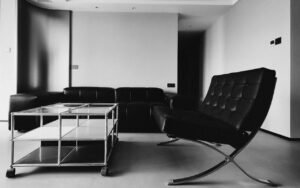
True to my studio’s style, most of my bedrooms are soft and close to monochrome: warm whites, gentle grays, deep charcoal on one wall, a natural wood floor. Quiet palettes simply ask less of the eye. If a client wants color, I steer toward muted, low-contrast shades, like a dusty blue, sage or clay, rather than bright, saturated ones.
Comfort is about more than looks. Many people sleep better in a cooler room, so I think about ceiling fans, operable windows and where the heating vents land. A small fan can also provide steady background sound if the street is noisy. Bring in fresh air during the day when you can, and keep plants to a few easy, low-light varieties that will not turn into a chore.
Storage that keeps the calm
Clutter is visual noise. I aim for closed storage in bedrooms wherever possible: dressers with drawers rather than open shelves, a closet with doors and under-bed drawers for extra linens. The nightstand gets a drawer too, so the surface can stay nearly empty with just a lamp, a book and a glass of water.
Inside the closet, I like a small, dedicated spot for tomorrow’s clothes, like a hook or a single shelf. Laying out the next day’s outfit takes two minutes in the evening and keeps the reading chair from turning into a second closet. A tray on the dresser catches keys, watches and jewelry so they do not drift onto every flat surface. These are tiny habits, but they make the room easier to keep calm, and a calm room is easier to rest in.
Key takeaway: Make the bed the focus, use warm layered light, add soft surfaces to quiet the room and remove anything that belongs to the daytime.
Your evening, redesigned
You do not need a full renovation to try this. Tonight, switch off the ceiling light after 8 p.m. and use a lamp instead. This weekend, move the laundry chair and the laptop out of sight. Next month, add a heavier curtain or a bigger rug. Each step makes the room a little quieter and a little kinder.
The bedrooms I am proudest of are not the most photographed ones. They are the rooms clients tell me they barely notice anymore, because the moment they lie down, they are already drifting off. That is exactly the point.

Nadia Rowe
Nadia designs quiet rooms with honest materials.




Start the conversation