A Home Library on Any Budget
Shelves, ladders and the art of arranging books so you actually read them.
 June Calloway6 min read

June Calloway
June writes about clothes, craft and the people who make things slowly and well.



A wall of books makes any room feel warmer. You do not need a mansion or a rolling ladder — just a plan and a few good shelves. Books bring color, texture and personality to a room in a way no decorative object can, and they quietly tell visitors who you are. The trouble is that most of our books live scattered across the house: a stack on the nightstand, a box in the closet, a crooked row on top of the dresser. Gathering them in one place, and arranging them with a little care, can turn even a small apartment corner into something that feels like a real library.
For advice, we turned to Margaret Lowe, a furniture maker in Burlington, Vermont, who has built bookshelves for homes of every size, from farmhouse parlors to studio apartments. She has strong opinions on where shelves belong, how books should be arranged and how to do the whole thing without spending much money. Here is her guide, along with a few ideas from Slow Sunday readers who have built libraries of their own.
 Sponsored · Hearthside CandlesHand-poured in VermontTwelve new fall scents, out now.Shop candles
Go floor to ceiling
Tall shelves on one wall look intentional. Short shelves scattered around look like storage. A single wall of books, running from the baseboard nearly to the ceiling, creates a focal point and makes a room feel taller. It also uses vertical space that usually goes to waste, which matters in smaller homes.
Margaret recommends choosing the wall carefully. A wall opposite a window gets good daylight without direct sun hitting the spines, which can fade covers over time. A wall around a doorway or a window frame can look wonderful, with shelves wrapping around the opening like a picture frame. Avoid exterior walls in older homes that tend to be damp in winter, since paper does not like humidity.
Shelf depth and spacing
Most hardcover novels fit on shelves about ten inches deep, and most paperbacks need only eight. Art books and atlases may need twelve or more, so plan a few deeper shelves near the bottom where heavy books belong anyway. For spacing, Margaret suggests about eleven inches between shelves for general fiction and fourteen inches for the bottom row of oversized books. Adjustable shelves make life much easier as your collection changes.
Arrange by how you read
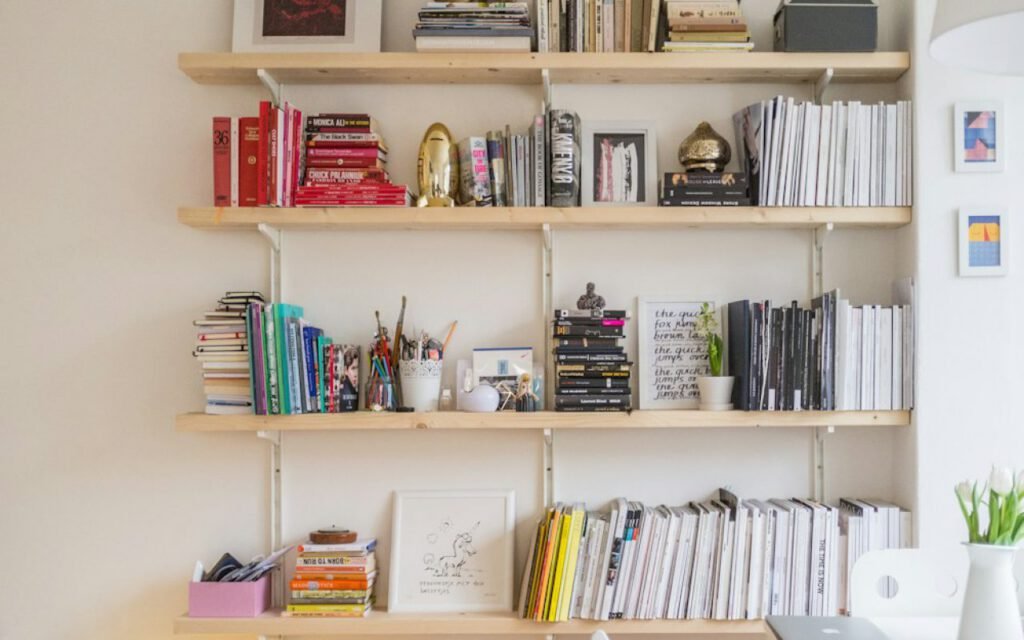
Keep the books you have not read yet at eye level. Favorites and reference books can go higher. It sounds backward at first. Most of us put our most treasured books front and center. But the shelf at eye level is the one you notice every day, and a row of waiting books there acts as a gentle reminder of what is next. The favorites you have already read three times do not need to be seen to be loved.
Sponsored · Hearthside CandlesHand-poured in VermontTwelve new fall scents, out now.Shop candlesNever organize books by color if you want to find them again.
Margaret Lowe, furniture maker
Rainbow shelves look striking in photographs, but they turn finding a particular book into a guessing game. Margaret suggests a simpler system: group books loosely by subject, then alphabetize by author within each group. Fiction in one section, history in another, cookbooks near the kitchen, children’s books on the lowest shelves where small hands can reach them. You do not need a library catalog, just enough order that you can find what you are looking for in under a minute.
Horizontal and vertical
Mixing a few horizontal stacks among the upright rows adds rhythm and gives shelves a relaxed, lived-in look. Stacks are also a practical solution for books too tall to stand upright. A short stack can act as a bookend, and the top of a stack is a handy place for a small object or a plant.
Leave some gaps
Add a plant, a photo or a small object every few shelves so the wall can breathe. A wall packed solid with books can feel heavy, even overwhelming. A few pauses give the eye somewhere to rest and make the whole arrangement feel more personal.
Choose objects with meaning rather than buying accessories to fill space. A framed photograph of a grandparent, a small bowl from a trip, a trailing pothos, a candlestick, a piece of driftwood picked up on a beach walk. Margaret suggests leaving roughly one gap for every three or four shelves, spread out in a loose zigzag pattern rather than lined up in a column.

Budget options
Built-in bookcases from a cabinetmaker are beautiful, but they can easily cost several thousand dollars. You can get a remarkably similar look for a fraction of that. These are Margaret’s three favorite ways to save:
- Simple wall-mounted brackets and boards
- A step stool instead of a ladder
- Good light on the shelves
Wall-mounted brackets screwed into studs, topped with pine boards from a lumberyard, can hold a surprising amount of weight. Paint the boards the same color as the wall, and the shelves almost disappear, leaving just the books. For heavy loads, use brackets every sixteen inches, and if you are not sure how to find studs or anchor shelves safely, ask a handyman or someone at your hardware store for help.
Freestanding bookcases from secondhand stores and estate sales are another bargain. Two or three matching cases pushed together and anchored to the wall look nearly built in, especially with a strip of trim added along the top. Always secure tall bookcases to the wall to prevent tipping, particularly in homes with children.
A sturdy two-step stool does the job of a rolling ladder for a tiny fraction of the price, and it tucks neatly into a corner. Finally, light: a simple picture light or a pair of clip-on lamps aimed at the shelves makes the books glow in the evening and turns the wall into a feature after dark.
Make a place to read
A library is only half finished without somewhere to sit. Place a comfortable chair, a small side table and a good reading lamp near the shelves. A footstool, a soft throw and a spot for a cup of tea complete the corner. One reader in Columbus, Ohio, turned a wide hallway into a reading nook with a single armchair and a wall of shelves on brackets; she says it is now the most used spot in her house.

Do not overlook the lowest shelves, either. Baskets or lidded boxes on the bottom row hide magazines, photo albums and board games, and they keep the shelves looking tidy. A small brass label or a handwritten card on each basket makes it easy to remember what is inside. If you have young children, give them one low shelf of their own, filled with picture books they can reach without help. Several readers told us that shelf became the busiest part of the whole library.
Key takeaway: One tall wall, a simple system, a few pauses and good light matter far more than expensive shelving.
A library that grows with you
The best home libraries are never finished. Books come in from bookstores, yard sales and friends; others leave for the little free library on the corner. Leave a little room on every shelf so new arrivals have somewhere to go, and once a year, pull out the books you know you will never read again and pass them on.
Margaret’s own shelves, she admits, are a mess of borrowed books, notes and pencil sketches tucked between the pages. That, she says, is exactly how a library should look. It should feel like someone actually lives there and reads.
June Calloway
June writes about clothes, craft and the people who make things slowly and well.


Start the conversation