



 MakersPortland Furniture Maker Graham Pell on Slow Joinery, Local Wood and Chairs That Outlive UsFrom a small Central Eastside shop, Pell builds about 60 pieces a year. He explains why…
Written by
Ana Ruiz
Ana ran a two-person design studio for nine years. She asks the questions every small business owner is thinking.
11Articles
2026Writing since
In a red barn outside Lexington, Kentucky, Owen Harlan works at his wheel from seven every morning. Chefs from New York to San Francisco serve their food on his bowls. On the morning we visited, a light fog still sat over the pasture, and the barn doors were rolled open to let in the cool air. Inside, shelves stretched to the rafters, lined with hundreds of pieces in various stages of life: soft gray bowls drying on wooden boards, pale pink pieces waiting for glaze, and finished work in deep browns, creamy whites and a soft green the color of creek water.
Owen throws about 3,000 pieces a year, nearly all by himself, with help from a single part-time assistant who glazes and packs orders. Every bowl, plate and cup is made by hand on the same wheel he has used for nineteen years. His work is now sought after by some of the country’s most celebrated restaurants, yet he still answers his own phone, still sweeps his own floor and still takes the time to explain every step of his process to a curious visitor.
From the barn
The barn was built in the 1920s for drying tobacco, and when Owen bought the property, it was leaning, leaky and full of old farm equipment. He spent two years restoring it, replacing rotten boards, pouring a concrete floor and running power for his wheel and kilns. Today it is both his studio and, in a way, his signature. Many of the restaurants that use his work describe it on their menus simply as bowls from the barn.
Owen grew up in eastern Kentucky and took his first pottery class in high school, mostly, he admits, to get out of study hall. He went on to study ceramics in college, then spent several years as an apprentice to an older potter in North Carolina, where he learned the discipline of making the same form hundreds of times until his hands knew it by heart. When he returned to Kentucky, he wanted to make simple, sturdy pots meant to be used every day.

Local clay
He digs some of his clay from the creek bank behind the barn and mixes it with stoneware from a nearby supplier. Digging and processing wild clay is slow, messy work. Owen hauls buckets of it up the hill, soaks it in water, strains out roots, stones and sand through a fine screen and lets it dry to a workable consistency. On its own, the local clay is too unpredictable to use for everyday pots, so he blends it with a reliable commercial stoneware body, which gives him strength and consistency.
The creek clay adds something he cannot buy: small flecks of iron that bloom into dark speckles in the kiln, and a warm, earthy tone that shows through his glazes. He also experiments with glazes made from local materials, including wood ash from his own fireplace, which gives some of his pieces a soft, mottled surface.
A bowl should feel good in your hands before it looks good on a shelf.
Owen Harlan, potter
A day at the wheel
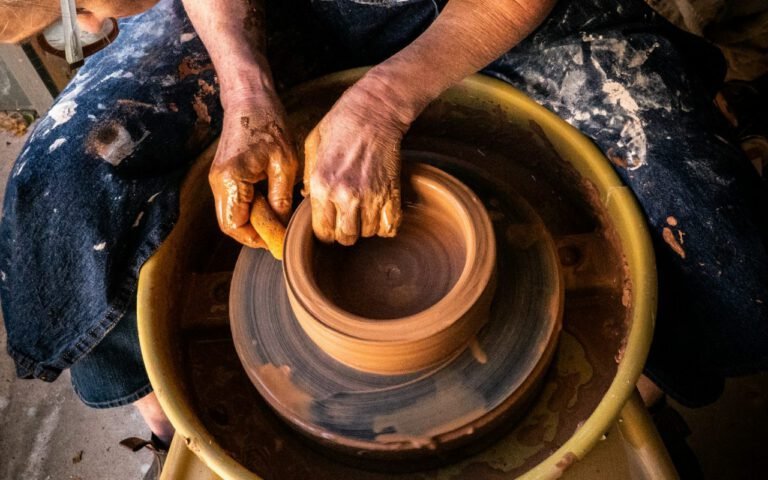
Owen’s days follow a steady rhythm. He arrives at the barn just before seven, makes coffee on a hot plate and begins by wedging clay, kneading it on a canvas-covered table to remove air bubbles and even out its texture. By seven, he is at the wheel, throwing a single form in batches. On a typical morning, he might make forty identical cereal bowls, or twenty large serving bowls, or sixty small cups.
Working in batches is the key to making so many pieces. The repetition builds speed and consistency, and it frees his mind to notice small refinements in each piece. In the afternoon, he trims the pieces thrown the day before, which have dried to a leather-hard state, carving their feet and refining their shapes. Glazing and firing happen in cycles over the week. He fires his kilns two or three times a week, each firing lasting most of a day and a night, followed by a full day of cooling.

Imperfect on purpose
Every bowl is made by hand, so every bowl is slightly different. That is what chefs love about them. Factory dinnerware is identical, perfectly smooth and uniform. Owen’s bowls carry the marks of their making: faint throwing rings on the walls, a slightly uneven rim, glaze that pools darker in some places and runs thin in others. No two are the same.
The chefs who order from him say those small differences bring food to life. A simple dish of roasted vegetables or a bowl of soup looks warmer and more generous on a handmade plate. One chef who runs a farm-to-table restaurant in Charleston, South Carolina, told Owen that his bowls make diners slow down and actually look at what they are eating. Owen considers that the best compliment he has received.
Built for restaurants
Restaurant pottery has to be tough. It is washed many times a day in commercial dishwashers, stacked in busy kitchens and handled by dozens of people every night. Owen works closely with each restaurant to design pieces that stack neatly, survive heavy use and suit the chef’s food. He fires his stoneware to a high temperature, which makes it dense and durable, and he tests every new glaze carefully before it goes into production.
Open studio days
Twice a year, the barn opens to visitors, and seconds are sold for half price. On a Saturday in May and another in November, cars line the gravel drive and fill the pasture. Visitors watch Owen throw, tour the kilns, ask questions and browse tables of finished work. Seconds are pieces with small flaws, a tiny glaze skip, a slightly warped rim or a little kiln mark, that are not quite right for restaurants but perfectly usable at home.
For many visitors, the open days are a chance to own a piece of the same pottery they have eaten from at a favorite restaurant. Local musicians play in the yard, a food truck parks by the gate and children run between the pumpkin patch and the barn. Owen says the open days are the busiest and happiest of his year.
Living with handmade
Owen believes handmade pottery belongs on the kitchen table, not locked away in a cabinet for special occasions. His advice to anyone who buys a handmade piece is simple:
- Use handmade pottery every day
- Most stoneware is dishwasher-safe — check the maker’s note
- Buy seconds: small flaws, same beauty
Most stoneware handles everyday use well, but every potter’s work is a little different, so read the care card or ask the maker about the dishwasher, microwave and oven. Avoid sudden temperature changes, such as moving a bowl straight from the refrigerator into a hot oven, which can cause cracks. And do not be afraid of seconds. A tiny flaw is often invisible once a bowl is filled with soup.
Key takeaway: Handmade pottery is meant to be used. Buy from a maker you trust, follow their care notes and enjoy the small differences.
A life at the wheel
As we prepared to leave, Owen was already back at the wheel, a fresh lump of clay spinning under his hands. He told us he has no plans to expand, hire a large team or move to a bigger building. He likes knowing that every piece leaving the barn has passed through his own hands. Somewhere tonight, in a restaurant hundreds of miles away, someone will lift one of his bowls without a thought for the barn, the creek or the early mornings that made it. That, he says with a shrug, is exactly how it should be.
Written by
Ana Ruiz
Ana ran a two-person design studio for nine years. She asks the questions every small business owner is thinking.
11Articles
2026Writing since
Read next
MakersPortland Furniture Maker Graham Pell on Slow Joinery, Local Wood and Chairs That Outlive UsFrom a small Central Eastside shop, Pell builds about 60 pieces a year. He explains why… Growing SlowlyFamily-Run Hardware Store Celebrates 75 Years in the Old North EndThree generations, one cash register and a cat named Bolt.
 MakersLocal Coffee Roasters Brace for Higher Bean Prices This WinterWholesale prices are up 30 percent this year. Small cafés say a $6 latte may be…
 MakersThe Farmers Market Is Moving Indoors for Winter — and Staying Open WeeklyForty vendors will set up in the old train depot every Saturday from November to April.
 MakersLearning the Pottery Wheel at 50One reader’s year of wobbly bowls — and why making things by hand is the best…
Start the conversation