 Marcus Bell6 min read
Most bad haircuts are communication problems. The barber was skilled, the clippers were sharp and the chair was comfortable, but somewhere between what you pictured and what you said, the message got lost. “Just a little off the sides” means something different to every person who says it. “Short on top” could mean an inch or a buzz. And by the time you notice the gap, the hair is already on the floor.
Here is how to get the cut in your head. After years behind the chairs at Sharp & Co. Barbers, our team has learned that a great haircut starts before the clippers turn on. A few minutes of clear conversation, a couple of photos and some honest answers about your routine will do more for your next cut than any product on the shelf.
Bring a photo
Two or three photos of cuts you like, and one you don’t. That is the single best thing you can do for your barber. Words are vague; pictures are not. A photo shows length, shape, texture and how the sides blend into the top in a way that would take five minutes to describe and still might not land.
Try to find photos of people whose hair is similar to yours. If your hair is thick and wavy, a photo of a cut on straight, fine hair will only tell part of the story. Look for a similar hair type, a similar hairline and, if possible, a similar face shape. Save them in an album on your phone so you are not scrolling while the barber waits.
Why the “don’t” photo matters
Showing a cut you dislike is just as useful as showing one you love. It tells your barber where your boundaries are. Maybe you like a short cut, but not one that shows scalp on the sides. Maybe you want texture, but not the messy look that is popular right now. One quick “not this” photo can prevent the most common surprises.
Tell us about your mornings
Tell us how you style it in the morning. That changes everything.
Marcus, master barber
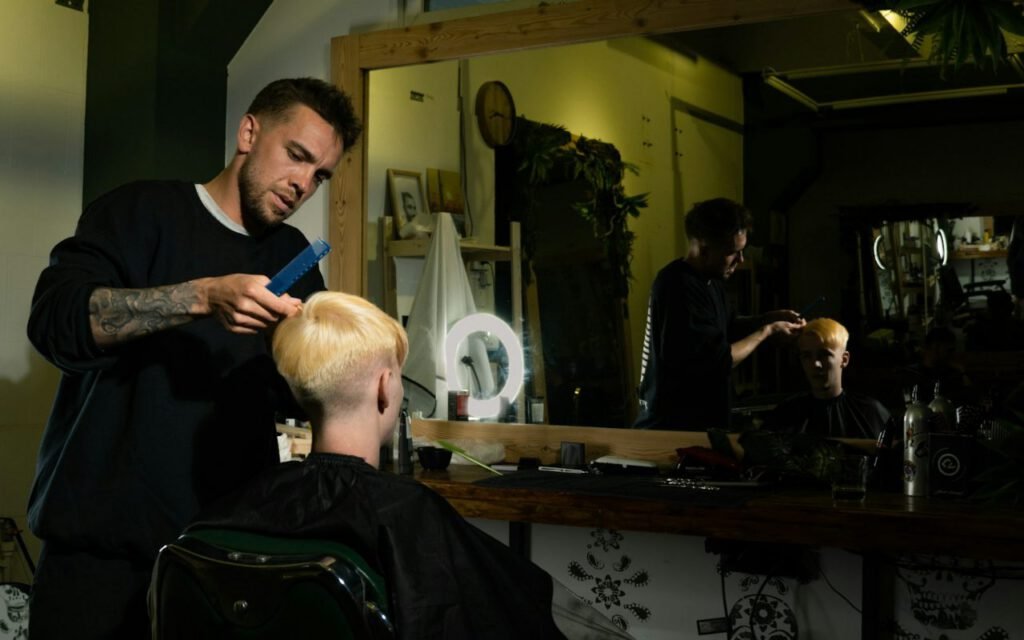
Marcus has been cutting hair at Sharp & Co. longer than anyone else on the team, and this is the question he asks every new client. A cut that looks perfect when the barber styles it with product and a blow-dryer might be impossible to recreate if you roll out of bed and run your fingers through it. Your barber needs to know the real version of your routine.
Be honest about a few things:
- How much time you actually spend on your hair each morning
- Whether you use product, and which kind: pomade, clay, cream or none
- Whether you blow-dry or let it air dry
- If you wear a hat, helmet or headset often
- Any dress code at work or school
There is no wrong answer. A barber who knows you have two minutes and no product will cut differently, leaving the hair at a length and shape that falls into place on its own. A barber who knows you love styling can leave more length on top for you to work with.
Know a few words
Taper or fade, length on top, and whether you want the neckline squared or natural. You do not need to speak like a barber, but a handful of terms will make the conversation much easier.
Taper or fade
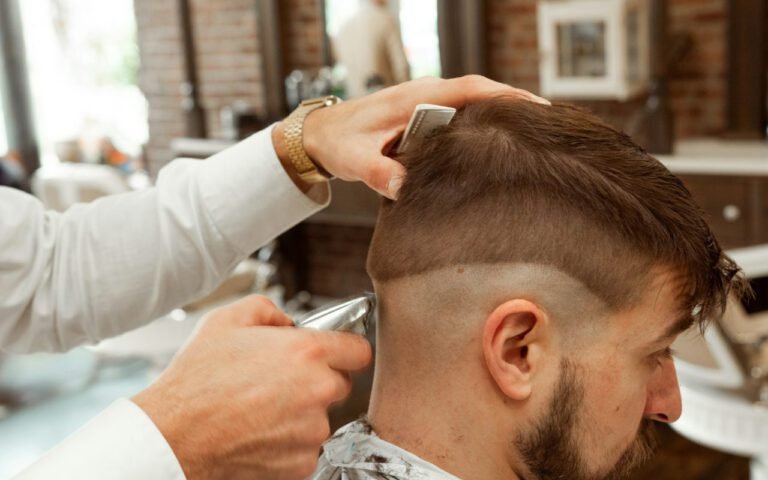
Both describe how the hair gets shorter as it moves down the sides and back. A taper is a more gradual, conservative change and usually leaves some length near the bottom. A fade goes shorter, often down to the skin or very close to it, for a sharper contrast. If you are not sure which you want, ask your barber to show you on a photo.
Length on top
Try to give a real measurement or show it with your fingers. “About two inches” or “long enough to push back” is far more helpful than “not too short.” If you know a clipper guard number you like on the sides, mention it; a lower number means shorter hair.
The neckline
The back of the neck can be finished square, rounded or natural. A squared or blocked neckline looks crisp right after a cut but can look untidy sooner as it grows. A natural or tapered neckline follows your hairline and grows out more gracefully. Neither is better; it depends on how often you plan to visit.
Speak up during the cut
Good barbers check in as they go, but you are allowed to speak up, too. If something looks shorter than you expected after the first pass, say so right away. It is far easier to adjust the plan early than to fix it at the end. A good barber will never be offended by a polite question.
A few phrases that help:
- “Can we go a little longer on the sides than that?”
- “Could you show me how much you are taking off the top before you cut?”
- “I usually part it on the left. Can you cut with that in mind?”
- “How should I style this at home?”
That last question is one of the most valuable you can ask. Your barber knows exactly how they shaped the cut, so they can tell you how much product to use and which direction to comb it. Ask them to talk you through it while they finish.
Key takeaway: Bring photos, describe your real routine and ask questions during the cut. Your barber can only cut what they understand.
Build a relationship with one barber
The best haircuts often happen on the third or fourth visit with the same barber. By then, they know your cowlicks, your hairline, how fast your hair grows and what you liked about the last cut. Each visit becomes a small refinement instead of a fresh guess. If you find someone you trust, book with them again, and do not be shy about telling them what worked and what did not.
If something about a cut does not work once you have lived with it for a week, tell your barber at the next visit. Maybe the top was a little too short to style, or the sides grew out faster than you expected. That kind of honest feedback is exactly what helps a barber dial in your cut. Nobody gets every detail right the first time, and a good shop wants to hear it rather than have you quietly go somewhere else.
It also helps to keep a steady schedule. Most short cuts look their best when refreshed every three to four weeks, and longer styles every five to six. Booking your next appointment before you leave the shop makes it easy.

Walk out with the cut you pictured
Photos, numbers and honest talk. That is the whole formula. Bring two or three pictures you like and one you do not, tell your barber how you actually style your hair in the morning, and learn a few basic words like taper, fade and neckline. Then keep talking during the cut and ask how to style it at home.
Next time you sit in a chair at Sharp & Co., start with the photos and the morning routine. We will take it from there, and you will walk out looking like the version of yourself you had in mind.

Marcus Bell
Marcus reports from the statehouse and runs our election data desk.


Marcus Bell
Marcus reports from the statehouse and runs our election data desk.



2 Comments
Thanks for explaining this so clearly.
Great reporting — please keep following this story.