



 CultureSummer Concert Series Announces Its Biggest Lineup YetTwenty free shows by the river, from jazz to bluegrass to a full orchestra on the…
Culture Jake Wilson7 min read
Gaming Café Becomes the Neighborhood’s Favorite After-School Hangout
Homework first, then games: how one owner turned a vacant storefront into a safe place for 200 teens a week.
Jake Wilson7 min read

Written by
Jake Wilson
Jake writes the weekly Fix It column and answers reader questions.
5Articles
2026Writing since
At Level Up Café, the rule is simple: homework first. Once a teacher-volunteer checks it off, students get two hours on the gaming PCs. On a Tuesday afternoon in October, the line at the homework table stretches nearly to the door, a dozen middle schoolers holding worksheets and laptops and waiting, with surprising patience, for a retired math teacher to look over their fractions.
Owner Ryan Cooper opened the café in a vacant storefront last year. About 200 teenagers now come through each week. What started as a small business bet has turned into something closer to a community center, one with glowing keyboards, a snack counter and a whiteboard listing every student who finished a book report on time.
A storefront nobody wanted
The building sits on a commercial strip between a laundromat and a tax preparation office. Before Cooper signed the lease, it had been empty for almost three years. The previous tenant, a phone repair shop, left behind cracked floor tiles and a sign that still hangs, faded, in the back room.
Cooper, 38, worked in IT support for a regional hospital system for more than a decade. He spent much of his free time building gaming computers for friends and coaching a youth basketball team. When the hospital consolidated its tech staff, he took a buyout and started looking for a way to combine those two interests.
“I kept seeing the same thing with the kids I coached,” he said. “After practice, they had nowhere to go. Their parents were at work until six or seven. A lot of them went home to an empty house and played games alone until dinner.”

Homework first, then games
The homework rule was not part of Cooper’s original business plan. It came from a conversation with a parent who said she would happily pay for gaming time if she knew her son’s assignments were done. Cooper liked the idea so much that he made it the center of the café.
Every weekday from 3 to 6 p.m., at least two volunteers staff the homework table. Most are retired teachers. A few are college students studying education at the nearby state university. They do not do the work for anyone. They check that it is finished, answer questions and occasionally send a student back to try again.
Kids were going to play games anyway. Now they play them here, with adults around and snacks that aren’t just chips.
Ryan Cooper, owner
Joyce Hammond, who taught seventh-grade English for 29 years, has volunteered three afternoons a week since the café opened. She said the atmosphere is different from a classroom in a good way. “They’re motivated,” she said. “Nobody has ever rushed through a vocabulary list faster than a kid who knows there’s a tournament starting in 20 minutes.”
How a typical afternoon works
- Students sign in at the front desk with a parent-approved account.
- They bring their assignments to the homework table and work until a volunteer signs off.
- Students with no homework can read for 30 minutes from the café’s small library instead.
- Once cleared, they get two hours of computer or console time.
- Parents receive a text when their child signs in and again when they leave.
What the kids actually play
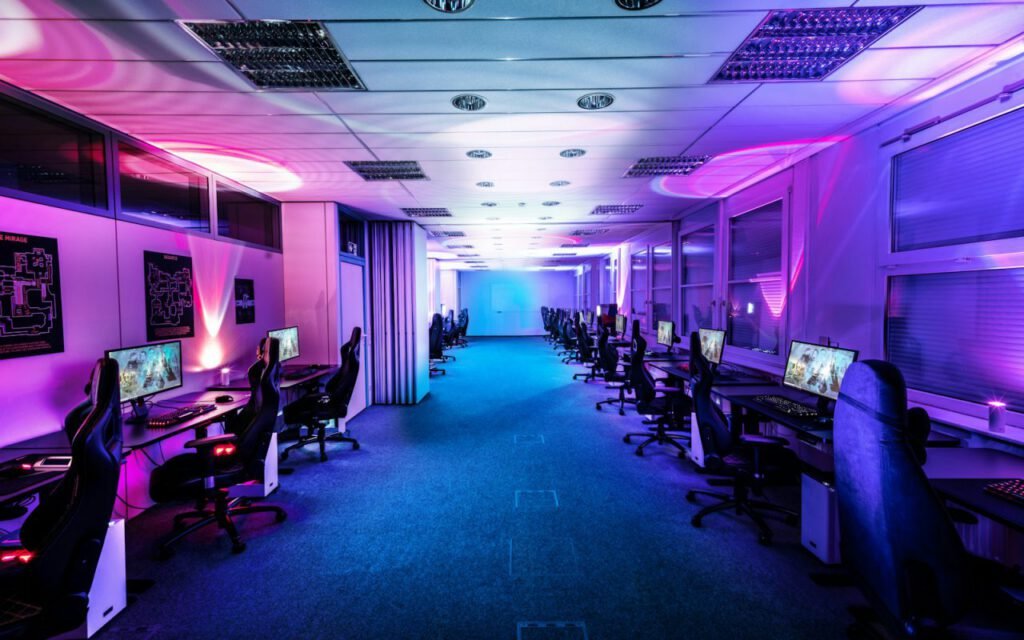
The café has 24 gaming PCs, six console stations and a projector that turns one wall into a giant screen for group games. Cooper keeps the library of games rated for teens and younger, and he and his staff watch the room closely. Headsets stay on, and language stays clean. Anyone who breaks the rules loses their time for the day.
Popular choices shift every few months. Building games and team-based strategy titles are the steady favorites, Cooper said, along with a racing game that has inspired a long-running rivalry between two eighth-grade girls who have never lost to anyone else.
The snack counter is a point of pride. Cooper partnered with a local deli to offer sandwiches, fruit cups and yogurt alongside the usual pretzels and sodas. Prices are low, and any student who cannot pay can get a free snack, no questions asked. A local church covers the cost.
Cooper also keeps a close eye on screen time. Two hours is the hard limit on school days, and staff remind players when they have 15 minutes left. Between sessions, students are encouraged to stand up, stretch and grab water. On nice afternoons, Cooper sometimes moves everyone outside for a quick game of four square in the parking lot, which he says is more popular than anyone expects. “They complain for about 30 seconds,” he said. “Then they don’t want to come back in.”
Parents said the supervision is what sold them. One mother of two regulars said she used to worry about who her son was talking to in online games late at night. At the café, she knows an adult is in the room and that the games are chosen with teenagers in mind. “It’s not perfect,” she said. “But it’s a lot better than not knowing.”
Tournaments that give back
The café hosts a weekend tournament each month and donates entry fees to the middle school’s robotics club. Entry costs $10, and most tournaments draw between 40 and 60 players, from sixth graders to a few parents who sign up for fun and usually lose.
So far, the tournaments have raised enough to buy the robotics club two new competition kits and cover travel to a state competition. The club’s adviser, science teacher Derek Lawson, said the money arrived at exactly the right time.
We had more kids interested than we had parts for. Now every team has its own robot. That’s because of a bunch of kids playing video games on a Saturday.
Derek Lawson, robotics club adviser
The tournaments have become a social event in their own right. Families bring lawn chairs, younger siblings watch on the big screen and the deli next door does its best business of the month. Cooper streams the finals online, with two high school students handling the play-by-play.
Running a business with a mission
Level Up Café is a for-profit business, and Cooper is candid that it has been hard to make the numbers work. Students pay $5 for an afternoon session or $40 for an unlimited monthly pass. Evening sessions for adults, private party rentals and the tournaments help cover rent, power and equipment upgrades.
Some of the challenges he has faced in the first year include:
- Electricity bills that are far higher than he expected, especially in summer
- Replacing worn keyboards, mice and headsets every few months
- Finding enough volunteers to keep the homework table staffed every day
- Explaining to skeptical parents that the café is not just a place to waste time
That last point has eased as word spread. Several parents said their children’s grades have improved, though Cooper is careful not to claim credit. “I think it’s mostly that they have a routine now,” he said. “And somebody’s asking them every day whether the homework’s done.”
Key takeaway: By pairing a homework check with gaming time, Level Up Café has turned a vacant storefront into a safe, supervised after-school spot for about 200 teens a week.
What’s next for Level Up
Cooper hopes to add a coding and game design class in the spring, taught by a volunteer who works as a software developer. He is also talking with the school district about a summer program that would mix reading time, outdoor activities and supervised gaming.
For now, the afternoons look much the same. The homework line forms at 3 p.m. The volunteers settle in with their red pens. And one by one, students get the nod they have been waiting for, grab a headset and head for the glowing screens in the back. Cooper said that moment, the one where a kid finishes the last problem and grins, is still his favorite part of the day.
Written by
Jake Wilson
Jake writes the weekly Fix It column and answers reader questions.
5Articles
2026Writing since
Read next
CultureSummer Concert Series Announces Its Biggest Lineup YetTwenty free shows by the river, from jazz to bluegrass to a full orchestra on the… CulturePodcast Studios Are the New Coworking SpacesRent a soundproof room by the hour: inside the boom in shared studios for creators and…
 CultureMaking a Short Film on Your PhoneA weekend project with friends and zero budget.
 CultureCloud Gaming Hits 30 Million Monthly Players in the USBetter home internet and cheaper plans are pushing streaming games into the mainstream.
 CultureBinge or Weekly? The Great TV Release DebateWhy some shows drop all at once and others make you wait.
2 Comments
Sharing this with my friends.
Saved this one for later. Really useful.