



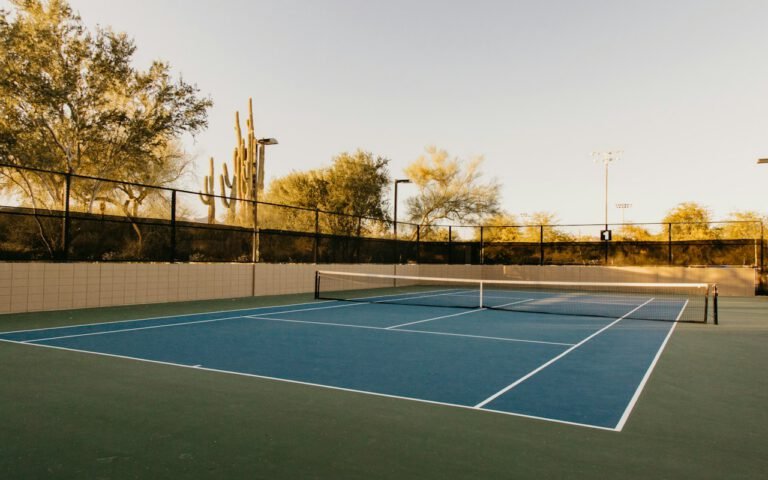
 Tennis & GolfTennis Courts Get a Makeover — and Pickleball LinesTwelve public courts reopen this weekend with new surfaces, lights and shared lines for both sports.
Tennis & Golf Brooke Sutton6 min read
College Tennis Star Elliot Navarro Is Turning Pro — and He Ran the Numbers First
A two-time All-American skips his senior year. He has a budget, a coach and a plan to break into the top 200.
Brooke Sutton6 min readBefore he told his coach, his teammates or his parents that he was leaving college to play professional tennis, Elliot Navarro opened a spreadsheet. It had 41 rows: flights, hotels, coaching fees, stringing, tournament entries, physical therapy, health insurance, a used car. At the bottom, a single number estimated what his first year as a pro would cost. Then he added a column for what he might earn. The gap between the two was large enough that he spent most of a weekend staring at it.
Navarro, a 21-year-old two-time All-American at a large public university in the Southwest, announced on Monday that he would skip his senior season and turn professional. He finished last year ranked third in the national college rankings and won 34 of his 39 singles matches, including a run to the semifinals of the national championship in May. His professional ranking, earned in a handful of summer events, sits in the mid-400s.
Why now
The decision was not about one great match. It was about timing. Navarro reached the final of two lower-level professional tournaments in July and August, beating three players ranked inside the top 300 along the way. Those results earned him enough ranking points to enter bigger events this fall, and he worried that waiting another year would cost him momentum he might never get back.
“The college season is great, and I loved my team,” Navarro said by phone this week. “But in tennis, your ranking is your passport. Right now I have one that gets me into tournaments where I can actually move up. If I wait a year, I start over.”
His college coach, Diane Mercer, said she supported the decision fully, even though it leaves her team without its top player. Mercer has coached at the university for 17 years and has seen seven players turn pro early. “Some of them were ready and some of them weren’t,” she said. “Elliot is the first one who came into my office with a budget. That told me a lot.”

The real cost of the lower levels
Professional tennis looks glamorous from the top. Below the top 100 or so, it is a hard way to make a living. Players outside the top 200 usually pay their own travel and coaching costs, and prize money at entry-level tournaments can be small enough that a player who loses in the first round leaves the week in the red.
Navarro’s spreadsheet estimated his first-year expenses at about $92,000, a figure several coaches and players we spoke with described as realistic for a carefully run budget. That number broke down roughly like this:
- Coaching and travel for a part-time coach: about $38,000.
- Flights, hotels and ground transportation for 25 to 28 tournaments: about $31,000.
- Strings, racquets, shoes and equipment not covered by sponsors: about $7,500.
- Physical therapy, fitness training and health insurance: about $11,000.
- Entry fees, phone, and everything else: about $4,500.
To cover the gap, Navarro has a combination of support. A regional tennis foundation that helps young American players has committed a $25,000 grant. A local racquet company has agreed to provide equipment. His family is contributing what it can, and he plans to coach junior clinics during weeks when he is home. He will also share hotel rooms with other players whenever possible, a common practice on the lower circuits.
Everybody tells you to chase your dream. Nobody tells you the dream has a monthly budget. I wanted to know exactly how long I could afford to give it a real shot.
Elliot Navarro, on turning pro
A game built for the next level
Scouts and coaches who have watched Navarro describe a player with a professional-level backhand and a serve that still needs work. He stands 6-foot-1, moves well for his size and is comfortable hitting both flat and with heavy topspin from the back of the court. His two-handed backhand down the line is the shot that won him most of his college matches.
His serve is the main question. Navarro won about 68 percent of points on his first serve in college, a solid number but not a dominant one. On faster professional courts, against players who return serve for a living, that number will likely drop. He has spent the past two months working with a new coach, former touring pro Sam Becker, on adding speed and disguise to his first serve.
Becker, who peaked in the top 120 during his own career, will travel with Navarro for about half the tournaments this year. “He has the ground strokes to be a top-100 player,” Becker said. “The serve will decide how fast he gets there. We are not trying to turn him into a big server overnight. We are trying to get him five or six free points a set.”
What his teammates lose, and gain
Navarro’s departure leaves a sizable hole in a college lineup that was ranked in the national top 15 to start the fall. Mercer plans to move a junior from Phoenix into the top singles spot and has added a transfer from a smaller program to deepen the lineup. Teammates say they were not surprised by the decision, only by how early in the summer he made it.
Several of them helped him prepare. Two teammates spent August playing practice sets with him at 6:30 a.m., before the desert heat set in, and the team’s volunteer assistant, a retired accountant, checked his spreadsheet for errors. He found two. “He had forgotten baggage fees and visa costs for the Mexico events,” Navarro said, laughing. “That was about $1,200 I didn’t know I was spending. It was a good lesson. The small things add up fast on the road.”
Keeping a backup plan
Navarro is three classes short of a degree in sports management, and he has enrolled in two online courses this fall to finish while on the road. His parents, both public school employees in Albuquerque, made that a condition of their support, and he did not argue. “I want to play tennis for 12 years,” he said. “But if I get hurt in year two, I want a diploma, not a story about what could have been.”
He has also set himself a clear checkpoint. If he is not ranked inside the top 250 within 18 months, he plans to sit down with his family and coach and reassess. He says that is not a lack of confidence but a recognition of how the sport works. Plenty of talented college players never break through, and the ones who keep chasing for too long can find themselves in their late twenties with debt and no plan.
The first stop
Navarro’s professional schedule begins next week at a tournament in Tulsa, where he will play in the qualifying draw. From there he will travel to events in Texas, California and Mexico before the season ends in November. He has already printed the schedule and taped it to the wall above his desk, next to the spreadsheet.
Mercer, his college coach, plans to watch the first match online with the team. “We will all be yelling at a laptop in the locker room,” she said. “And then we will go practice, because we have a season to play without him.”
Brooke writes the Sunday column and runs a marathon every spring.

Written by
Brooke Sutton
Brooke writes the Sunday column and runs a marathon every spring.
7Articles
2026Writing since
Read next
Tennis & GolfTennis Courts Get a Makeover — and Pickleball LinesTwelve public courts reopen this weekend with new surfaces, lights and shared lines for both sports. Tennis & GolfA Qualifier Reaches the Open Semifinal — and Brings Her Mom as CoachRanked 142nd in the world two weeks ago, she has now beaten three seeded players in…
 Tennis & GolfGolf’s Newest Star Learned the Game on a Nine-Hole Public CourseGreen fees were $12. He played every day after school for eight years. On Sunday he…Tennis & Golf212 Golfers, a $35 Entry Fee and One Night-Shift Champion: Inside the City AmateurAt the 61st City Amateur, a forklift operator, a retired teacher and a 15-year-old all chased…
Nobody ever talks about how expensive the lower tour levels are. This was eye-opening.
Smart kid. Keeping the degree option open is exactly the right call. Good luck to him.
Saw him play at the regional championships last spring. That backhand is the real deal.