


 LifeThe Case for a Phone-Free HourOne hour a day, no screens, real rest.
Written by
Hana Sato
Hana covers objects, rooms, cities and good type — and the people who make them.
10Articles
2026Writing since
My first real desk was an old door on two sawhorses. I still use it. It has followed me through three apartments, one long winter in a rented farmhouse, and a season when I was sure I would quit writing altogether. The door is a plain hollow-core slab, painted a tired shade of cream by someone long before me, and the sawhorses came from a hardware store clearance bin for less than the price of a good lunch. Every essay on this blog was drafted on it. When people ask me what I write with, they usually mean software or pens. The honest answer is a door.
You don’t need a beautiful office. You need a flat surface and a reason to sit down. I spent years believing the opposite. I bookmarked photos of airy studios with built-in shelves and brass lamps, and I told myself the real work would begin once the room was right. The room was never right. The work began the week I stopped waiting and dragged a door in from the curb.
Why a cheap desk works better
There is a quiet freedom in a desk you are not afraid to ruin. I spill coffee on mine. I write phone numbers in pencil along the edge. Once, in a fit of revision, I taped an entire chapter outline across its surface and left it there for a month. Nobody gasped. Nothing was lost. An expensive desk asks to be protected. A door just asks to be used.
A cheap desk also keeps the stakes in the right place. When the furniture costs almost nothing, the only valuable thing in the room is the page. I find that clarifying. If the morning goes badly, I have not failed to live up to a showroom. I have simply had a slow morning at a slab of wood, which happens to everyone.
And there is the practical side. A door is enormous compared with most writing desks. Mine is about 30 inches deep and nearly 80 inches long, which means the laptop can live at one end while a stack of library books, a printed draft and a mug all fit comfortably at the other. I have room to spread out, and spreading out is half of how I think.
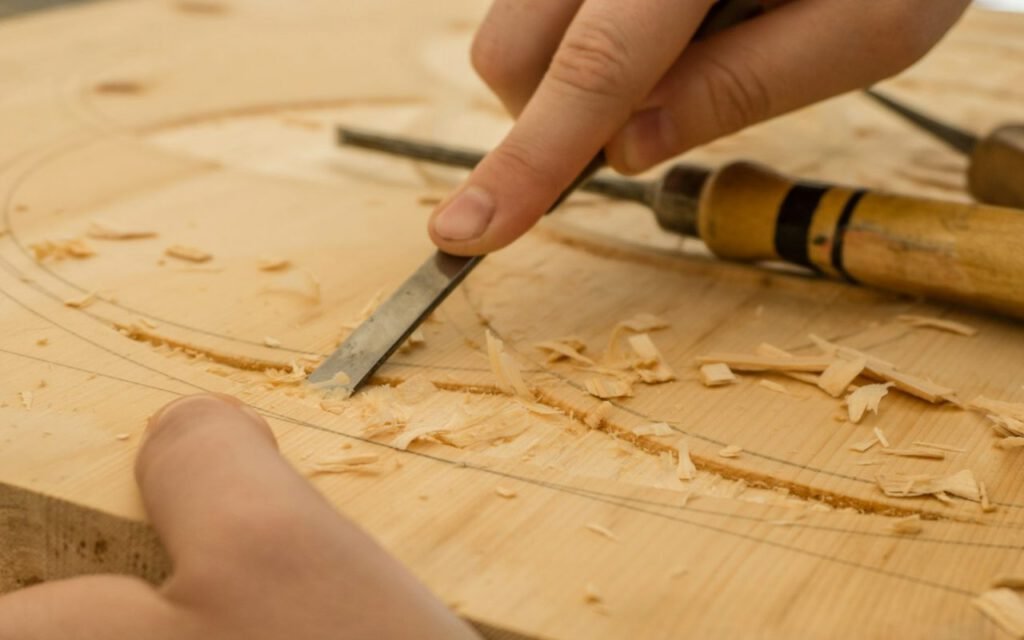
How to build one this weekend
If you want to try it, the whole project takes an afternoon and very little skill. I have helped two friends set up their own versions, and both were writing at them by dinner. Here is the short version of what we did.
- Find a door. Salvage yards, building reuse centers and neighborhood swap groups often have hollow-core interior doors for a few dollars. A solid door is sturdier but much heavier, so ask for help carrying it.
- Get two sawhorses or trestles. Folding plastic ones work. Wooden ones look warmer. Aim for a finished height of roughly 28 to 30 inches, which suits most chairs.
- Cover the knob hole. A small square of thin plywood glued over the hole does the job, or simply put that end against the wall and let it hold a cup of pens.
- Sand and seal. A light sanding and a coat of clear water-based finish keeps splinters away and makes spills easy to wipe.
- Check it for wobble. Felt pads under the feet and a level floor make a surprising difference. If it still rocks, a folded piece of cardboard is a perfectly respectable fix.
My total, back when I built mine, came to under $40, and most of that was the finish. If you already own a folding table, a plank or even a sturdy board laid across two short bookcases, you may not need to spend anything at all. The point is not the door itself. The point is a wide, honest surface that belongs to your writing and nothing else.
Light matters most
Put the desk by a window, and add one warm lamp for winter afternoons. If I could give only one piece of advice about a writing space, it would be this one. I have written in basements and in closets, and I have written in front of a big east-facing window. The window wins every time. Daylight makes the hours feel shorter and the sentences feel less cramped. When I look up from a stuck paragraph, I want to see a tree or a strip of sky, not a wall.
I set my door at a right angle to the glass rather than facing it directly, so the light falls across the page instead of into my eyes. In the morning the sun comes in low over my left shoulder, and by noon it has moved off the desk entirely. That is when the lamp takes over.
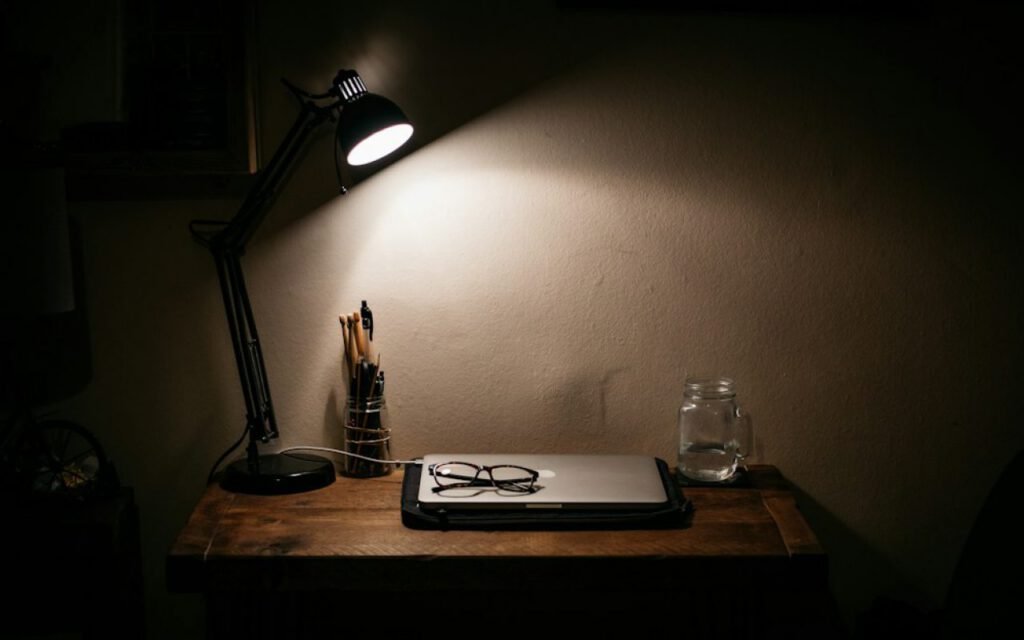
The lamp is the only thing on my desk I would call nice. It is an old secondhand one with a cloth shade, and I paid a little more for it than I paid for the door. I chose a warm bulb on purpose. Cold white light makes me feel like I am filling out forms. Warm light makes me feel like I am writing letters, and letters are closer to what I am actually trying to do.
The best desk is the one you actually sit at.
Nora
I wrote that line on an index card years ago and pinned it above the first version of this desk. It has outlasted several fancier ideas about how a writing life should look, and I still believe it completely.
Keep it bare
A notebook, a pen, a cup. Everything else lives in a drawer. My door does not have drawers, of course, so mine is a plastic bin underneath it, but the rule is the same. When I sit down to write, the surface in front of me should hold only the things I need for the next hour.
This took me a long time to learn. For years my desk was a museum of good intentions: a stack of unread magazines, a jar of dried-out highlighters, three notebooks I had started and abandoned, a tangle of chargers. Every object was a small request for attention. Clearing it all away felt drastic at first, then it felt like breathing.

Here is what stays out, and only this:
- One notebook for the current project, open to a fresh page.
- One pen I like, plus a pencil for margin notes on printed drafts.
- One cup, usually coffee before noon and tea after.
- The laptop, closed until I have written at least a paragraph by hand.
At the end of each session I take two minutes to reset the desk to that state. It is the smallest ritual I have, and it may be the most useful. Tomorrow’s version of me arrives to a clean surface and a sentence already waiting in the notebook, which makes starting much less frightening.
Key takeaway: A writing space needs three things: a flat surface, good light, and as little clutter as you can stand. Everything else is decoration.
The desk is not the point
I want to be careful here, because it would be easy to turn this into another kind of perfect-office fantasy, just a thriftier one. The door is not magic. Plenty of people write beautifully at kitchen tables, in cars during a lunch break, or on a phone propped against a library window. If your space is borrowed or shared or temporary, you are in very good company.
What the door taught me is that the desk is only a promise you make to yourself. It says, here is a place where writing happens. The cheaper and plainer that place is, the less it can distract you from keeping the promise. I sit down, I move the cup to the right, I open the notebook, and the door gets out of the way.
If you have been waiting for the right room before you begin, consider this a gentle nudge. Find a flat surface near a window. Clear it off. Put one good lamp on it. Then sit down tomorrow morning and write a single page. The door on my sawhorses has held hundreds of those pages by now, and it still cost almost nothing.
Written by
Hana Sato
Hana covers objects, rooms, cities and good type — and the people who make them.
10Articles
2026Writing since
Read next
LifeThe Case for a Phone-Free HourOne hour a day, no screens, real rest. LifeThe Tea Ritual: Ten Minutes That Change Your MorningBoil the kettle, put down the phone and let the tea steep. That’s the whole practice.
 IdeasThe Year I Stopped Reading the News Before NoonWhat happened to my attention — and my sentences — when mornings went quiet.
 WorkMindfulness at Work: Five Micro-BreaksTiny pauses that make long days easier.
 LifeForest Bathing: A Beginner’s Guide to Walking SlowlyNo hiking, no destination — just two hours among trees with all five senses.
 WorkHow to Negotiate a Job Offer: Salary, Benefits and Sign-On TermsA calm, step-by-step way to ask for more salary, better benefits and a fair sign-on bonus.
 LifeThe Ten-Minute Walk ResetStep outside, breathe, notice — then come back.
 WorkWorking Remotely From the RoadHot spots, library Wi-Fi and the day the signal died.IdeasDo Trees Talk? What the Science Really SaysFungal networks connect roots — but scientists are still debating what that means.
Start the conversation