Painting a Mural in Six Days
Ladders, sunscreen and 40 gallons of paint.
 Pip Moreno6 min read
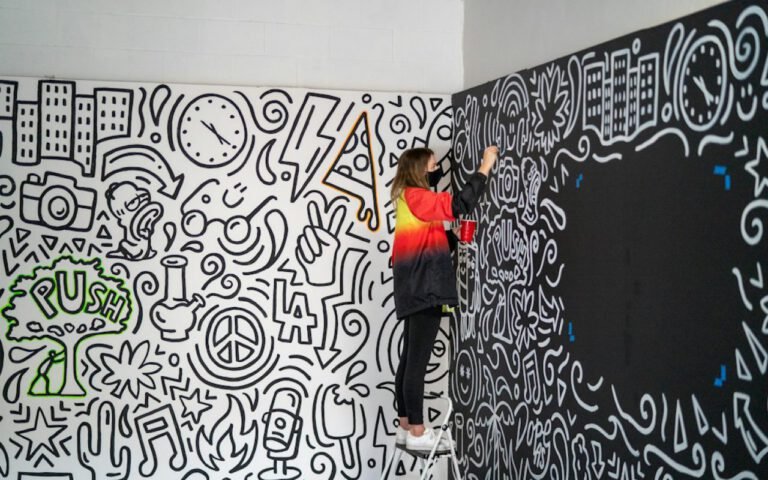
My biggest project this year was a mural on the side of a neighborhood grocery (a fictional client for this demo). The wall was about forty feet long and fourteen feet high, faced west and caught the full afternoon sun from about one o’clock on. When I first stood in front of it with my sketch rolled up under my arm, it looked enormous. By the end of the week, it felt like an old friend.
Six days, two ladders and a lot of neighbors stopping to chat. Here is how it came together, what I learned and what I would do differently next time.
Before the paint
The design took longer than the painting. The store owners, a brother and sister who had run the grocery for nineteen years, wanted something that felt like the neighborhood: bright, friendly and full of food. We met three times over coffee. I showed them rough sketches of a long market table stretching across the wall, with people, produce and a very happy dog.
Once they approved the final sketch, I made a scaled color study at one inch to one foot, so a fourteen-inch-tall painting represented the full wall. That study was my bible for the whole week. Every color I mixed on the wall, I checked against it.
Prepping the wall
A mural only lasts as long as the wall underneath it. The store hired a local painting crew to pressure wash the brick, patch cracks and roll on a primer made for exterior masonry. I could not have done that part alone, and I would not have wanted to. Good prep is the difference between a mural that lasts ten years and one that peels after two winters.
Grid it first
I scaled my sketch onto the wall with a chalk grid. Old trick, still the best. On my small color study, I drew a grid of one-inch squares. On the wall, I snapped matching chalk lines every foot, using a chalk line and a long level. Then I numbered the rows and lettered the columns on both the study and the wall.
From there, it is like a puzzle. Square C-7 on the study has the top of a watermelon and the edge of a woman’s sleeve, so I draw exactly that in square C-7 on the wall. It is slow at first, then suddenly the whole drawing appears, and you step back across the parking lot and see it at full size for the first time.

Other artists use projectors or digital tracing methods, and they work well too. I like the grid because it works in daylight, needs no power and keeps me close to the wall from the start.
Six days, day by day
Here is roughly how the week went:
- Day one: chalk grid and full outline in thinned paint. Ten hours, two sore shoulders.
- Day two: blocked in the sky and background with big rollers and wide brushes.
- Day three: the market table, fruit and vegetables. So many tomatoes.
- Day four: people. Faces always take longer than you plan.
- Day five: the dog, shadows, highlights and fixing everything that looked wrong from across the street.
- Day six: final details, signature and a clear protective coat.
In total, I used about 40 gallons of exterior acrylic paint, three rollers, more brushes than I can count and a full bottle of sunscreen. I started each morning at 7 a.m. to beat the heat and stopped painting the sunny section once the afternoon sun hit it, moving to the shady end instead.
Staying safe up high
Two ladders and a rented rolling scaffold got me to the top of the wall. I always had someone nearby when I was on the scaffold, kept the wheels locked and never leaned out past the rails. If you are planning your first mural, talk to the rental company about the right equipment and ask an experienced muralist to show you how they set up. Falling off a ladder is the fastest way to end a project.

Neighbors are the best critics
A kid told me the dog looked sad. She was right. I fixed it. She was maybe seven, holding her grandmother’s hand on the way into the store, and she stopped, looked up at the wall for a long time and said, very seriously, “Why is the dog sad?”
I looked at it and realized she was completely correct. I had painted the eyebrows tilted the wrong way. The next morning, I lifted the eyebrows, added a tiny tongue and turned the mouth up at the corners. When she came by later that week, she gave me a thumbs-up. That was the best review I have ever received.
Public art belongs to everyone who walks past it.
Pip
That is how I think about every mural now. In a studio, I am the only judge. On a wall, the whole neighborhood gets a vote. Over six days, people brought me iced tea, told me about the grocery’s history and asked if I could add their favorite vegetable. (The answer was often yes. There is a very small radish near the bottom left corner that was requested by a retired mail carrier named Walt.)
Here are a few things the neighbors taught me:
- People love to see work in progress. Do not hide it behind a tarp.
- Kids notice everything. Listen to them.
- Leave a few small details for people to discover later.
- Talking slows you down, and it is worth it every time.
On the last afternoon, the store owners set up a folding table by the front door with lemonade and cookies, and about fifty people came by to see the finished wall. A few of the regulars found themselves in it. The woman holding the basket of peaches has the same striped apron as the cashier who has worked the morning shift for eleven years, and when she noticed, she laughed so hard she had to sit down. The retired mail carrier found his radish. The little girl brought her grandmother back to check on the dog. I signed the bottom right corner while a small crowd counted down, which felt silly and wonderful at the same time. It was the closest thing to an opening night I have ever had.
What I would do differently
I would plan for a seventh day. Weather, a wind gust that knocked over a paint bucket and the extra time it takes to talk with people all added up. Six days was possible, but tight. I would also order more of the main background color than I thought I needed. Running out on day four and waiting for a matching mix was the most stressful afternoon of the week.
Key takeaway: prep the wall well, grid it carefully and budget time for the people who stop to say hello.
Why I keep saying yes to walls
Most of my work ends up in books, on packages or in magazines. It is wonderful, but I rarely see someone react to it in person. A mural is different. Every time I drive past the grocery now, someone is taking a photo in front of the market table, or a kid is pointing at the dog. That wall is part of the neighborhood now, and in a small way, so am I. If you have a wall that wants some color, I would love to hear about it.
Pip Moreno
Pip draws picture books, murals and happy little packages.




Start the conversation