Painting Big: Why Kids Love Large-Scale Art
Easels, windows and sidewalks become canvases — and confidence grows.
 Owen Blake6 min read

Owen Blake
Owen covers toddlers, big kids and the art of getting everyone out the door on time.



Painting on large surfaces uses the whole body and lets children experiment without worrying about the edges. Hand a seven-year-old a small sheet of printer paper and a thin brush, and you will often see careful, cramped strokes and a lot of erasing. Hand the same child a sheet of paper as tall as they are, a fat foam brush and a tray of paint, and something changes. Shoulders loosen, arms swing, colors collide and the whole project becomes a kind of dance. Large-scale art is not just a bigger version of the usual craft. It is a different experience, and big kids in particular tend to love it.
Why bigger feels better
Small paper asks for small, precise movements from the fingers and wrist. That is valuable practice, but it is also where many children start to feel frustrated, because their hands cannot yet make the picture they see in their heads. Large surfaces shift the work to the shoulder and the whole arm. Those gross motor movements are easier and more satisfying, and they still build the strength and coordination that later help with handwriting.
There is a confidence effect too. On a big sheet, a mistake is just a small part of a much larger picture. Kids worry less about staying inside the lines, because there are no edges close by to stay inside. They try bolder colors, mix more freely and are more willing to cover over something they do not like and start again.
Big paper makes for big ideas.
Marcus Hale, elementary school teacher
Marcus Hale tapes a long strip of paper along one wall of his classroom at the start of every term and leaves it there for weeks. Students add to it during free time, a planet here, a river there, until it becomes a sprawling shared world. He says even his quietest students find a corner to claim, and that the conversations around the mural are some of the best of the year.
Where to paint
A roll of paper taped to the wall, an easel outdoors or washable paint on the sidewalk. You do not need a studio. You need a surface big enough to move around and a plan for mess.
Indoors
Rolls of brown packing paper or white butcher paper are inexpensive and last for many sessions. Tape a long piece to a wall at your child’s height, with an old sheet or shower curtain on the floor underneath. A sliding glass door or large window also works beautifully with washable window paint, and the light coming through makes the colors glow. A flattened appliance box makes a sturdy canvas that can lie on the floor or lean against a wall.
Outdoors
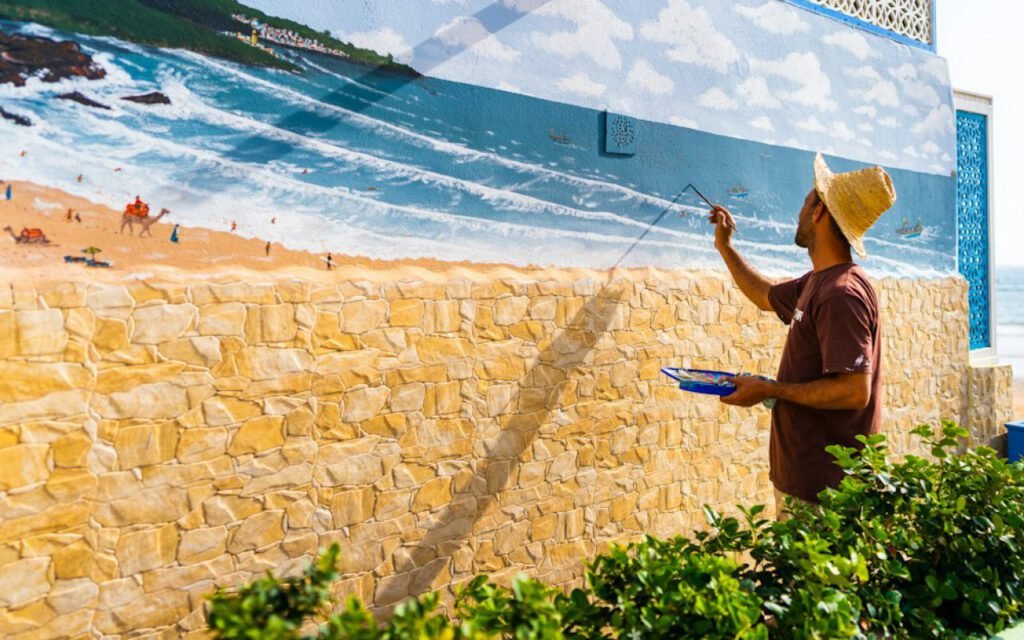
Outside, the options grow. A freestanding easel on the patio, paper clipped to a fence or a large cardboard sheet on the lawn all work well. Sidewalk paint, which you can buy or make with cornstarch, water and food coloring, turns a driveway into a canvas that washes away with the next rain or a garden hose. On warm days, kids can paint a fence or wall with plain water and a big brush, watching their pictures fade in the sun, which is especially fun for younger siblings.
Big brushes
Foam brushes and rollers are easier for small hands. Thin artist brushes are frustrating on a big surface, because it takes forever to fill any space with color. Wide tools let kids cover ground quickly and see results right away.
Here is a starter kit for large-scale painting:
- Foam brushes in two or three widths
- Small paint rollers and shallow trays
- Wide house-painting brushes from the hardware store
- Sponges cut into shapes for stamping
- Squeeze bottles for drips and splatter
- Washable tempera paint in a few bright colors plus white
Do not overlook unusual tools. Old toothbrushes make great splatter, spray bottles filled with watered-down paint create misty effects and toy cars rolled through paint leave wonderful tracks. Kitchen items like whisks, potato mashers and forks make fascinating textures.
Projects to try
Large-scale art can be completely open-ended, but some kids like a starting point. These ideas give just enough structure to get going.
- Body outlines. Have your child lie down on paper while you trace around them, then let them paint themselves as a superhero, an astronaut or whatever they choose.
- A family mural. Each person paints one section of a long sheet, then everyone connects the sections with roads, rivers or vines.
- Music painting. Play different songs and paint how each one feels. Fast songs get quick strokes; slow songs get long, flowing lines.
- Giant map. Paint an imaginary island or a map of your neighborhood, complete with landmarks and secret spots.
- Cardboard city. Paint large boxes as buildings, then arrange them into a town for toy cars and figures.
Keeping the mess manageable
The fear of mess stops a lot of big painting before it starts. A little preparation makes it much easier. Dress kids in old clothes or a large T-shirt, roll up sleeves and lay down a drop cloth wider than you think you need. Pour small amounts of paint at a time; you can always add more. Keep a bucket of soapy water and a stack of rags nearby for brushes and hands.
A few safety basics are worth a mention. Choose paints labeled nontoxic and made for children, and keep younger siblings from putting brushes in their mouths. If kids are painting on an easel or a propped-up board, make sure it is stable and will not tip if a child leans on it. On sunny days, set up in the shade, bring water and add sunscreen, since a painting session can easily stretch to an hour or more.
Displaying giant art
Big art needs a big home. A hallway, a staircase wall or the inside of a garage door can become a rotating gallery. If a painting is too large to keep, cut out a favorite section and frame it, or use the paper as gift wrap for grandparents. Photograph the full piece first, with the artist standing proudly beside it, so you always remember the scale.
Most of all, choose your timing. Big painting is perfect for a warm afternoon, the hour before bath time or a weekend morning with nowhere to be. Avoid starting a project just before you need to leave the house.
Key takeaway: Washable paint, a drop cloth and a bucket of soapy water turn a big, messy idea into an easy yes.
Quick tips
- Use washable paint
- Paint outside in good weather
- Let them help clean up
Cleaning up is part of the activity, not a chore that follows it. Kids can rinse brushes, wipe trays and roll up the drop cloth. It teaches responsibility, and many children find swishing brushes in soapy water almost as fun as painting.
Let them think big
Large-scale art gives children room, literally and figuratively. It invites bold choices, whole-body movement and collaboration, and it shows them that their ideas deserve space. The next time your big kid asks for something to do, skip the coloring book. Roll out a long sheet of paper, hand over a roller and step back. You may be surprised by how big their ideas turn out to be.
This article is general information, not medical advice. Talk to your own doctor or midwife about your family.
Owen Blake
Owen covers toddlers, big kids and the art of getting everyone out the door on time.

2 Comments
Thanks for explaining this so clearly.
Great reporting — please keep following this story.