
What to Do When Your AC Stops Cooling on a Hot Day
Three checks before you call — and when to call right away.
 Tasha Green6 min read
When the house hits 85°F in July, every minute matters. The kids are cranky, the dog is panting on the kitchen tile and someone has already opened every window, which only lets more hot air in. Before you panic, take a breath. A lot of cooling problems have simple causes, and some of them you can fix yourself in ten minutes without a single tool.
Try these three checks first; they fix about one call in five. That figure comes from our own dispatch records: roughly one in five summer “no cooling” calls turns out to be something the homeowner could have solved on their own. We would rather you save the service fee. And if the checks do not work, you will know exactly what to tell us when you call.
Check one: thermostat and breaker
Make sure it is set to Cool and a few degrees below room temperature, and that the outdoor breaker has not tripped. It sounds obvious, but thermostats get bumped, batteries die and settings get changed by curious kids or a well-meaning houseguest.
- Confirm the mode says Cool, not Heat, Off or Fan.
- Set the target at least three degrees below the current room temperature.
- If the screen is blank or dim, replace the batteries.
- Check that the fan setting is on Auto, not On. With the fan on and the compressor off, warm air just keeps moving around.
Next, go to your electrical panel. Look for a breaker labeled AC, condenser or outdoor unit, and another for the furnace or air handler. If either one sits in the middle position or is flipped to off, it has tripped. Push it firmly to off, then back to on. Many outdoor units also have a disconnect box mounted on the wall beside them; make sure that is switched on as well.
One important rule: if a breaker trips a second time after you reset it, leave it off and call us. A breaker that keeps tripping is protecting your system from an electrical problem, and repeated resets can make it worse.

Check two: the air filter
A clogged filter is one of the most common reasons an air conditioner stops cooling well on a hot day. When airflow drops, the indoor coil gets too cold, moisture freezes on it and cooling slows to a trickle. The system may still be running, but the air coming out of the vents feels barely cool.
Pull the filter and hold it up to a light. If it is gray, matted or you cannot see light through it, replace it. If you do not have a spare, run the system without cooling for a little while rather than without a filter; a missing filter lets dust coat the coil, which causes a bigger problem later.
If you see ice
Look at the copper refrigerant lines near the indoor unit and at the larger line running to the outdoor condenser. If you see frost or ice, turn the system to Off and set the fan to On. That moves air across the frozen coil and helps it thaw. It can take a few hours. Once the ice is gone and the filter is fresh, switch back to Cool. If it freezes again, the cause is likely low refrigerant or an airflow problem we need to look at.
Check three: the outdoor unit
Walk outside and look at the condenser. On a hot day it should be humming, with the big fan on top spinning and warm air blowing out the top. Check for a few things:
- Is the fan spinning? If the unit hums but the fan is still, turn it off and call us.
- Is the coil clear? Grass clippings, cottonwood fluff and leaves can blanket the sides. Gently rinse the fins from the outside with a garden hose on a soft setting, with the power off.
- Is there space around it? Keep at least two feet clear on all sides. Shrubs, patio furniture and trash cans can choke airflow.
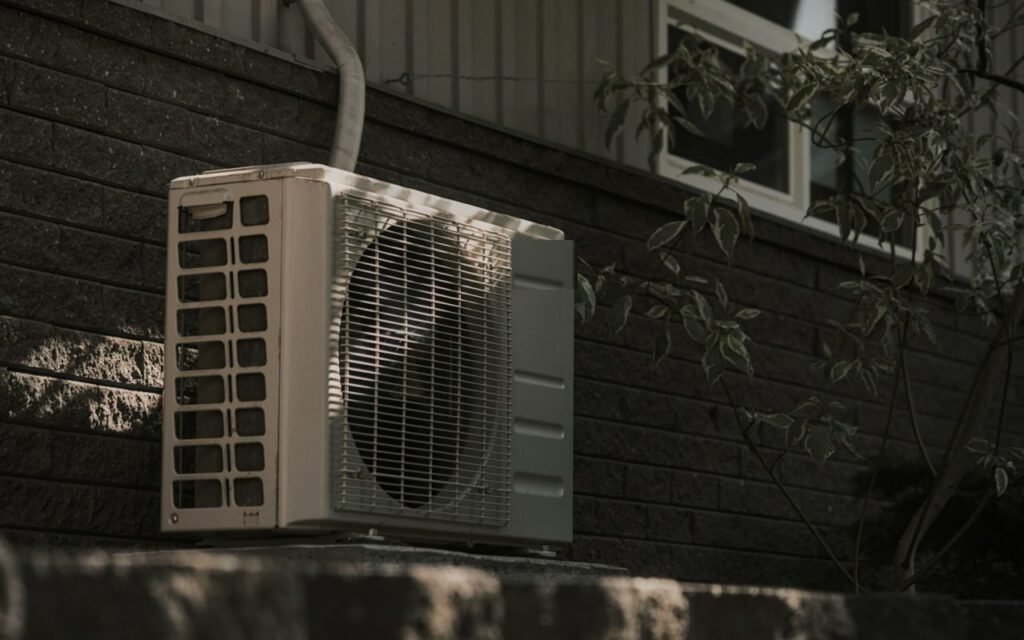
Never take panels off the outdoor unit or poke inside it. The capacitor inside can hold a dangerous electrical charge even with the power off. Rinsing the outside of the coil is fine; anything beyond that is a job for a licensed technician.
When to stop and call
Ice on the lines, a burning smell or a humming unit that will not start: turn it off and call us. Those are the three signs we never want homeowners to work around. Here is why each one matters.
Ice that comes back after you have changed the filter and let the coil thaw usually means low refrigerant or a failing blower. Running the system that way can damage the compressor, which is the most expensive part of the whole system.
A burning or electrical smell can mean a motor is overheating or wiring is damaged. Turn the system off at the thermostat and the breaker, and call right away. If you ever see smoke, leave the house and call 911 first.
A humming unit that will not start often points to a failed capacitor or a stuck motor. Leaving it running while it strains can burn out the compressor. Turn it off and let us replace the part.
Our 24/7 line answers in under a minute, all summer long.
Tasha
Tasha manages our dispatch team, and she has built the summer schedule around that promise. A real person answers, asks a few quick questions about what you are seeing and gives you an arrival window. If you have already done the three checks, tell her. It helps our technician arrive with the right parts.
Staying cool while you wait
If you are waiting on a repair during a heat wave, a few simple steps help keep the house bearable:
- Close blinds and curtains on the sunny side of the house.
- Run ceiling fans counterclockwise so they push air down.
- Skip the oven and dryer until evening.
- Keep everyone hydrated, and check on older family members and pets often.
- If the heat becomes dangerous for anyone in your home, go to a cooler place, like a library or a community cooling center your city opens during heat advisories.
Key takeaway: thermostat, breaker, filter, outdoor unit. Check those four, and stop the moment you see ice, smell burning or hear a hum without a start.
What to tell us when you call
A few details help our technician arrive ready. Note the age of your system if you know it; the outdoor unit usually has a label with a manufacture date. Tell us what you see and hear: is the outdoor fan spinning, is the indoor blower running, is there water near the furnace, is there ice anywhere? Mention which checks you already tried, including whether you reset a breaker and whether it tripped again. If you have a maintenance plan with us, say so right away so you are placed in the priority queue. And if anyone in the house is especially sensitive to heat, like an infant, an older adult or someone with a medical condition, let the dispatcher know. We do our best to move those calls up the list during the hottest days of the summer, and that information helps us make good decisions about the schedule.
One last thing
Most summer breakdowns do not come out of nowhere. Weak capacitors, dirty coils and clogged drains show warning signs months before they fail. A spring tune-up catches most of them before the first heat wave. If your system gave you trouble this year, ask about a fall check-up and a spring visit next year. The best emergency call is the one you never have to make.

Tasha Green
Tasha keeps sixty visits a day on time.





Start the conversation