Outlining a Novel Without Losing the Magic
Index cards, a corkboard and permission to change.
 Elliot Hayes6 min read

Elliot Hayes
Elliot writes novels about small towns and the people who leave them.


I used to think outlines killed the surprise. I believed, with the stubbornness of a young writer, that if I knew where a story was going, I would lose the thrill of discovering it, and so would the reader. I wrote by feel, following sentences wherever they wanted to go. Then I finished nothing for three years. I had a folder of brilliant beginnings, a few promising middles and not a single ending. Now I outline loosely, on index cards, and I have finished two novels and a story collection. Here is how I do it, and why I no longer think planning and magic are enemies.
This isn’t a rigid method. I teach it in workshops as a starting point, and every student bends it into something of their own. That is exactly how it should work. An outline is a tool, and tools should fit your hand.
Why I resisted outlining
My resistance wasn’t entirely wrong. The outlines I had seen in school were long, formal documents with roman numerals and subpoints, the kind of thing you write for a term paper. They felt finished before the story even started. Trying to write a novel from one felt like painting by numbers.
What I eventually realized was that the problem wasn’t planning. It was permanence. Those outlines were written as if they were contracts. Once a scene was on the list, it had to happen. My breakthrough came when I started treating the outline as a draft in its own right, as rough and changeable as any page of prose.

One card per scene
Who wants what, and what gets in the way. That is the only thing I write on each card, at least at first. I use plain three-by-five index cards and a black pen. One card holds one scene, and each scene needs three things:
- A character: whose scene is this?
- A want: what does that person need in this moment, even if it is small?
- An obstacle: what or who is in the way?
For example, a card from my last novel says: “June wants Margaret to admit she sold the house. Margaret wants to talk about anything else. The neighbor shows up with a pie.” That is enough. I don’t write dialogue on the cards, and I don’t describe the setting. I want just enough to know the scene has a pulse, and plenty of room left over for surprise.
If I can’t fill in all three parts, the scene probably isn’t a scene yet. It might be a mood, a memory or a nice image. Those can be useful, but they usually belong inside another scene rather than standing on their own.
An outline is a map, not a fence.
Elliot
The corkboard
Once I have thirty or forty cards, I pin them to a large corkboard above my desk. I lay them out in rows, roughly by chapter, with the first act at the top. Looking at the board from across the room shows me things I would never notice in a document. I can see when three scenes in a row belong to the same character, or when a subplot disappears for a hundred pages.
I also use a simple color system with markers along the top edge of each card. One color for each point-of-view character, one for scenes that move the main plot and one for scenes I am unsure about. When I step back and see a wall of “unsure” color in the middle of the book, I know where the real work is.
Leave blank cards
This is the part I care most about. I always pin a few blank cards in the board, scattered through the story. They mean, “Something happens here, and I don’t know what yet.” They are invitations. When I reach one in the actual writing, I let the characters decide. Some of my favorite scenes started as blank cards.
Shuffle often
The order changes every week. That’s the point.
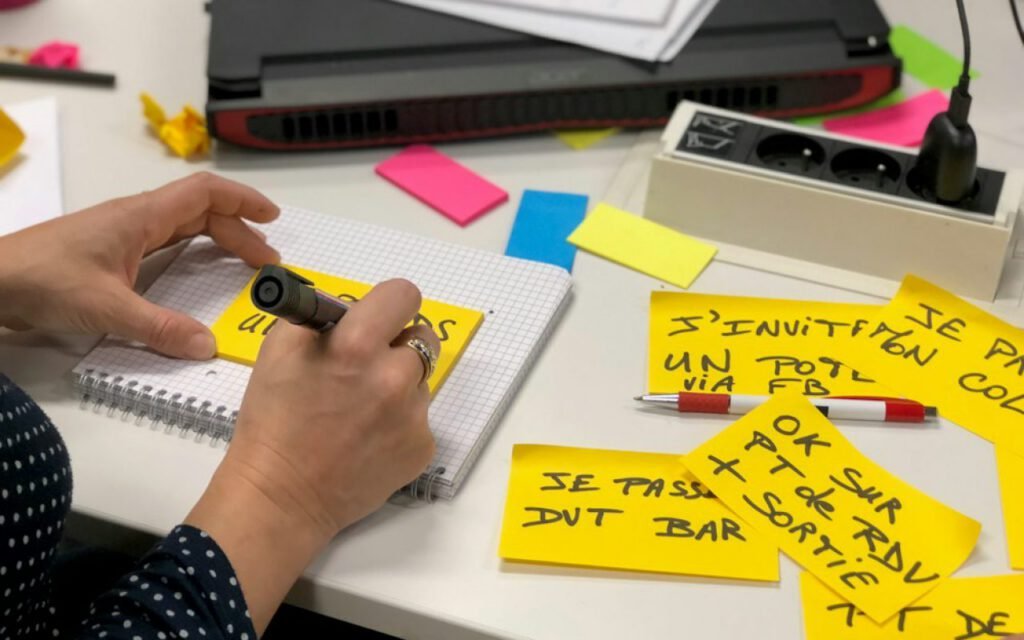
Every Friday afternoon, I take down a handful of cards and ask whether they are in the right place. Sometimes I move a revelation earlier, so the reader knows something the characters don’t. Sometimes I push a confrontation later to let the tension build. Occasionally I remove a card altogether and put it in a shoebox I call “the bench.” Cards on the bench aren’t deleted. They are just resting. A few have come back years later in different books.
Here is the weekly routine I give my students:
- Read the board from top to bottom out loud, one sentence per card.
- Mark any card that bored you while reading it.
- Ask whether each bored card can be cut, combined or moved.
- Add one new card somewhere unexpected.
- Take a photo of the board so you can always find your way back.
That photo step sounds minor, but it has saved me more than once. I have a phone full of pictures of corkboards, and scrolling through them is like watching the book evolve in fast motion.
Key takeaway: Change the outline as freely as you change your sentences. A plan you are afraid to revise is a plan that will eventually trap you.
Shuffling also keeps me honest. It is easy to fall in love with an early plan and protect it long after the story has outgrown it. Moving cards every week reminds me that nothing is fixed until the book is printed, and even then I sometimes wish I could move one more.
Keeping the magic
The fear that outlining will drain the joy out of writing is a real one, and I don’t want to dismiss it. What I have found is that the magic simply moves. It no longer lives in “What happens next?” Instead, it lives in “How does this happen?” and “What does it feel like?” Knowing that June will confront her sister in chapter twelve doesn’t tell me what she will say, what she will be holding or whether she will cry. Those are the discoveries that make writing a pleasure, and the outline leaves every one of them open.
The cards also give me courage. On a hard morning, I can look up at the board and pick any scene I feel like writing, not just the next one in order. Writing out of sequence used to feel chaotic. With the board, it feels like filling in a map I already trust.

Try it this week
If you are stuck in a story, buy a pack of index cards and spend one evening writing down the scenes you already know. Don’t worry about order. Just fill in who wants what and what gets in the way. Pin them up or lay them on the floor, then look at the whole thing at once.
You may find the story is closer to finished than you thought, or that a missing scene is suddenly obvious. Either way, you will have something to push against, and that is often all a stalled draft needs. The surprise is still there. It is just waiting on a blank card.
Elliot Hayes
Elliot writes novels about small towns and the people who leave them.


Start the conversation