 Owen Clarke7 min read
Most of my projects start with a two-hour workshop and a wall of sticky notes. Before I draw a single screen, before anyone opens a design file, I get the people who care about the product into one room, hand them a marker and a pad of yellow squares, and set a timer. It looks almost too simple. It is also the most valuable two hours of every project I take on.
Here’s the agenda I’ve refined over fifty of them. Some were with scrappy startup teams of four. Some were with thirty people from a regional bank, half of whom had never been in a design session before. The format has survived all of them, and I’m sharing it because I think more teams should run workshops like this, with or without a designer in the room.
One question
Every workshop answers one question, written big on the wall where everyone can see it. Not three questions. Not a list of goals. One.
Writing that question is the hardest part of my prep, and I usually go through several drafts with the project lead the day before. A bad question is vague: “How do we improve onboarding?” A good question is specific enough to argue with: “How might we get a new customer to send their first invoice in under five minutes?” The second version tells everyone what success looks like, who we are designing for and roughly how big the answer should be.
I write the question on a long strip of paper in thick black marker and tape it above the sticky wall. Whenever the conversation drifts, and it always drifts, I just point at it. Nobody has to be the bad guy. The question does the work.
A good workshop ends with fewer, better ideas — not more of them.
Owen
That line is the closest thing I have to a philosophy. Teams often walk into a workshop expecting a brainstorm that produces a hundred ideas. That feels productive in the moment, but a hundred ideas is just a new problem. What a team really needs at the end of two hours is one or two directions they believe in and a plan to test them.
Silent first
Everyone writes ideas alone before anyone talks. Quiet people have the best ideas.
I learned this the hard way. In my first few workshops, I opened with a group discussion. Within ten minutes, the most senior or most confident person in the room had framed the problem, and everyone else was politely building on their idea. The output was basically one person’s opinion with extra sticky notes.
Silent writing fixes that. For thirty minutes, the room is almost completely quiet. Everyone writes one idea per note, in short phrases, in marker so it can be read from across the room. I ask people to aim for quantity in this round, because the judging comes later. Engineers, salespeople, support staff and executives all get the same pad and the same timer.
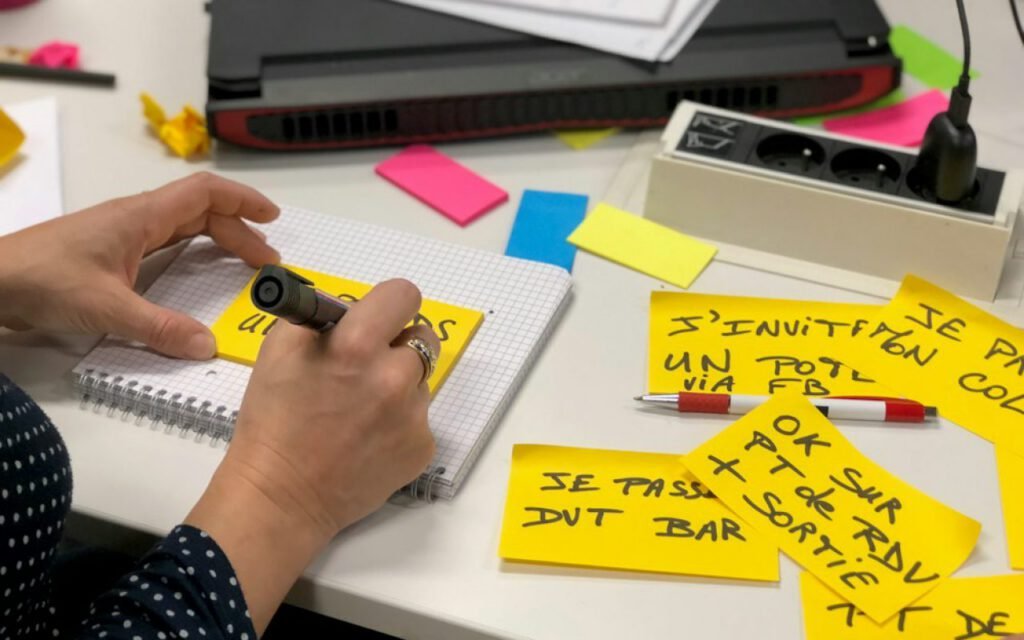
Some of the best ideas I’ve seen came from people who never would have spoken up in an open discussion. A support lead at a software company once wrote a single note that said “let people import last year’s invoices.” It became the most important feature of the release.
A few rules for the notes
- One idea per note, no paragraphs
- Marker, not pen, so everything is readable from a distance
- No names on notes, so ideas are judged on their own
- Anything goes, including the obvious answer
The agenda
This is the exact schedule I print and tape next to the question. Everyone can see where we are and how much time is left, which keeps the energy up and the tangents short.
- 10 min · the problem
- 30 min · silent ideas
- 30 min · group and vote
- 30 min · sketch the winner
- 20 min · next steps
Ten minutes on the problem
I open with the question, a few facts and, ideally, a real example. If we have customer quotes, support tickets or a short clip of someone struggling with the current product, this is where they go. The goal is to put everyone on the same page about what is broken and for whom, not to debate solutions.
Thirty minutes to group and vote
After silent writing, everyone sticks their notes on the wall. Then, still mostly quietly, we move them into clusters. Similar ideas go together, and each cluster gets a short label. Once the wall settles, every person gets three small dot stickers to vote with. They can put all three on one idea or spread them out. The decision-maker for the project gets a slightly larger dot that counts as a tiebreaker.
Voting silently matters as much as writing silently. It keeps people from campaigning for their own ideas, and it shows very quickly where the room’s energy really is.

Thirty minutes to sketch the winner
Now we finally talk. We take the top idea, sometimes the top two, and sketch what it might look like. I hand out paper with blank phone or browser outlines and ask everyone to draw a rough version in three or four frames. These sketches are terrible, and that is fine. They make the idea concrete enough to argue about, and they almost always reveal a question nobody had thought to ask.
Twenty minutes on next steps
The last block is where many workshops fall apart, so I protect it fiercely. We agree on who owns the winning idea, what we will build or test first, and when we will meet again. I write all of this on the wall in front of everyone and take a photo before we leave.
What I bring to the room
The kit is cheap and fits in a tote bag. I bring square sticky notes in one color, thick markers, dot stickers, painter’s tape, blank sketch templates and a kitchen timer. A physical timer works better than a phone because it sits on the table where everyone can see it, and it does not light up with notifications.
I also bring snacks. That sounds like a joke, but two hours is long, and a bowl of something on the table keeps people in the room during the slower moments.
For remote teams, I run the same agenda on a shared online whiteboard. Silent writing works even better remotely, because nobody can see who is typing. The key is to keep cameras on during voting and sketching, and to give people a real break halfway through.
Common mistakes I still see
After fifty workshops, I’ve made most of these mistakes myself at least once:
- Inviting too many people. Eight is ideal. Beyond twelve, the room gets slow and political.
- Skipping the problem framing because “everyone already knows it.” They never all know it.
- Letting the highest-paid person talk first.
- Ending without an owner. An idea without a name next to it is just a nice photo.
- Treating the output as final. The workshop picks a direction to test, not a finished design.
Key takeaway: Write one clear question, let people think alone before they talk, and never leave the room without an owner and a next step.
Try it next week
You do not need to be a designer to run this. You need a clear question, a quiet room, a timer and the discipline to stick to the agenda even when the conversation gets exciting. The first time will feel a little awkward, especially the silent parts. By the second or third, your team will start asking for them.
If you try it, I’d love to hear what changed. Every version of this agenda I use today came from someone who tweaked the last one and told me about it.

Owen Clarke
Owen designs calm software for complicated work.



Owen Clarke
Owen designs calm software for complicated work.



2 Comments
Thanks for explaining this so clearly.
Great reporting — please keep following this story.