 Mara Voss6 min read
Placement changes how a tattoo looks today and in twenty years. The same small swallow can look crisp and graceful on a shoulder blade and blurry and tired on a knuckle, even if the same artist used the same needle on the same afternoon. Skin is not paper. It moves, it stretches, it folds, it sees the sun and it changes as we get older. Where you put a design is just as important as what the design is.
Here’s what I tell clients who can’t decide. None of these are hard rules, and plenty of people have beautiful tattoos in “difficult” spots. But if you want your piece to age well, these are the questions worth asking before you sit in the chair.
Think about sun
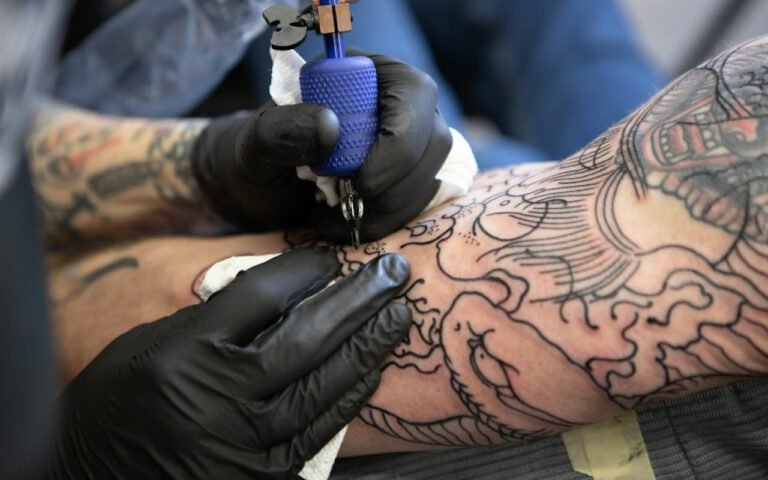
Forearms and hands get lots of sun. Sunscreen is your tattoo’s best friend. Ultraviolet light breaks down ink over time, and it is the single biggest reason a crisp black line slowly softens into a gray one. The areas that see the most daylight, like the outer forearm, the back of the hand, the tops of the feet, the back of the neck and the outer calf, are the ones that fade first.
That does not mean you should avoid those spots. Some of my favorite pieces in our portfolio are forearm botanicals. It just means you should go in with your eyes open and plan to protect them.
- Keep a fresh tattoo completely out of direct sun while it heals. Cover it with loose clothing rather than sunscreen during that time.
- Once it has fully healed, use a broad-spectrum sunscreen every time it will see daylight, and reapply when you are outdoors for long stretches.
- If you spend summers on the water or on a job site, consider a spot your clothes usually cover, like the upper arm or the back.
- Expect to come back for a touch-up on high-exposure spots every few years if you want them to stay bold.
Your dermatologist is the best person to ask about sun protection for your skin type. I just know what I see when clients come back after five summers at the lake.

Think about flow
Designs that follow the muscle look natural as you move. This is the part of placement that clients rarely think about, and it is the part artists care about most. A body is not a flat rectangle. It is curves and planes and long lines, and a tattoo that respects those shapes will look like it belongs there.
A long, vertical design such as a snake, a stem of flowers or a dagger usually looks best running along a long muscle, like the forearm, the shin or the side of the ribs. A round design such as a mandala, a sun or a compass likes a flatter, broader surface like the upper back, the chest or the outside of the thigh. If you force a tall design onto a wide area, or a round design onto a narrow, curving one, it will always look a little off, even if the line work is perfect.
The right spot makes a good design great.
Mara
During your consultation, I will often hold a stencil up to two or three spots and ask you to move around: raise your arm, twist, sit down, stand up. Watch how the design changes with you. If it bends in a way you like, that is a good sign. If a face looks strange every time you lift your arm, we try somewhere else.
Think about stretch and time
Our bodies change. We gain and lose weight, build muscle, carry children and simply get older. Skin in some areas stretches more than others, and a tattoo in those places will move with it.
Spots that tend to change more
The stomach, the hips, the inner upper arm and the chest can shift a great deal over the years. That does not ruin a tattoo, but it can distort fine details. If you are planning big life changes, like a pregnancy or a serious training program, it may be worth choosing another spot or waiting.
Spots that tend to stay steady
The outer upper arm, the shoulder blade, the calf and the upper back usually hold their shape well. These are some of the most popular placements for a reason. They are easy to cover for work, easy to show off and kind to ink over the long haul.
Fine line needs room
Ink spreads very slightly under the skin over time. Artists call it blowout or simply aging. On a large piece you will never notice. On a tiny fine line design with lettering two millimeters tall, those letters can blur into each other after a decade. If you love delicate work, give it more space than you think it needs, or pick a spot with thicker, steadier skin.

The spots artists love
Clients often ask where I would put a tattoo if it were on my own body. Here are the placements most artists in our studio would choose for themselves, and why.
- Outer forearm. Visible, easy to tattoo, great for vertical designs. Just protect it from the sun.
- Back of the upper arm. A smooth, steady canvas that ages well and is easy to cover with a T-shirt.
- Shoulder blade. Flat, wide and private. Perfect for round or symmetrical pieces.
- Calf. Lots of room, slow to change and a great home for long botanical designs.
- Thigh. One of the largest flat areas on the body, ideal for bold, detailed pieces.
And the spots we approach with care: fingers, palms, the sides of the feet and the inner lip. Skin there renews quickly and rubs against everything, so ink often fades or spreads within a year or two. We will still tattoo some of them, but we will be honest with you about what to expect and how often you might need a touch-up.
Key takeaway: pick a spot that matches the shape of your design, stays steady over time and can be kept out of the sun. Then let your artist help you fine-tune it.
Think about your life, too
Placement is not only about skin. It is also about how you live. If your workplace has a strict dress code, a hand or neck tattoo might cause headaches you do not want. If you are a runner, a fresh piece on your foot means skipping your training for a couple of weeks. If you love swimming, schedule a new tattoo for the fall, not right before your summer vacation.
Think about how often you want to see it, too. Some people love a tattoo they can look at every day while they drink their coffee. Others prefer something private that only a few people will ever see. Neither is better. It is your skin and your story.
Still not sure?
That is completely normal, and it is what consultations are for. Bring your idea, or even just a feeling you want to capture, and we will try a few placements together. We can print the stencil at different sizes, hold it up in the mirror and talk through how each option will look now and in twenty years.
There is no rush. A tattoo is one of the few things you get to keep for the rest of your life. Taking an extra week to choose the right spot is always worth it, and the right spot is the one that will still make you smile when you catch it in the mirror years from now.

Mara Voss
Mara draws custom fine-line, botanical and blackwork tattoos.



Mara Voss
Mara draws custom fine-line, botanical and blackwork tattoos.

Start the conversation