 Leo Park6 min read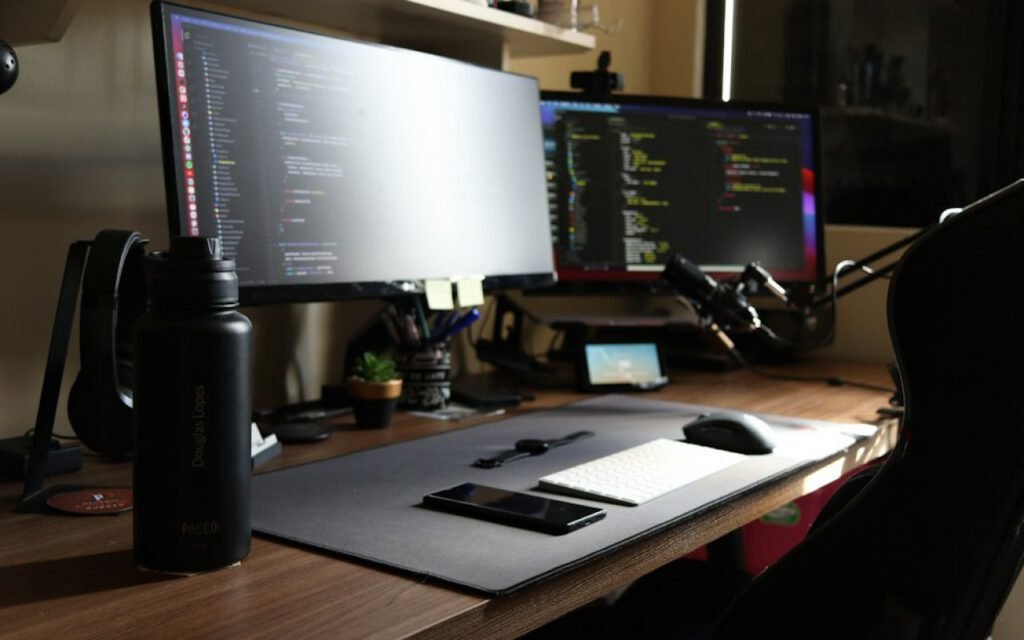
I do my best work after 9 p.m. My setup is built around that. For years I tried to force myself into a tidy nine-to-five rhythm, because that is what productive people supposedly did, and for years I spent the morning staring at code I could not quite untangle. Then one evening, after dinner and a short walk, I sat down to fix a stubborn caching bug and looked up to find it was midnight, the bug was gone and I had written the cleanest code of my month. That was when I stopped fighting my own clock.
It’s simple, quiet and very dark. Nothing in my workspace is expensive or special, and nothing here is advice you must follow. Everyone’s brain runs on its own schedule. But a lot of readers have asked about the late-night setup behind my build logs, so here is the whole thing, piece by piece, along with the reasons behind each choice.
One screen, on purpose
I used to run two large monitors side by side. It looked impressive in photos and felt productive, but in practice the second screen became a parking lot for distractions: chat on one side, email on the other, a dashboard of stats I did not need to watch. My attention kept drifting sideways.
Now I work on a single 27-inch monitor, set at eye level about an arm’s length away. When I need documentation next to my code, I split the screen in half. That small limit forces me to decide what deserves to be visible. Most nights the answer is just my editor and a terminal. The browser comes up only when I am actually testing something.
The editor theme is dark, of course, but not pitch black. I use a near-black background with soft, slightly warm text colors. Pure white text on pure black looks crisp in screenshots and feels harsh after two hours, a lesson I learned building a night-shift dashboard for a logistics client and then quietly applied to myself.
Warm light
A dim lamp behind the monitor keeps eyes relaxed. This is the single change that made the biggest difference, and it cost me about $25. Working in a fully dark room with only a bright screen creates a harsh jump between the glowing rectangle and the blackness around it. A little bit of soft light behind the monitor fills in that gap.

My lamp uses a warm white bulb, the kind with an amber tint, and sits low behind the desk so the light washes the wall instead of shining in my eyes. I also turn on my computer’s built-in night color setting around sunset, which shifts the whole screen slightly toward amber. Together they make the room feel more like a reading nook than an office.
I am not a doctor, and I will not pretend to know exactly how light affects sleep for everyone. If you have trouble with eye strain or sleep, it is worth talking to an eye doctor or your physician. What I can say is that, for me, warm and dim simply feels calmer, and calm is when I write my best code.
Notifications off
Phone in another room. Chat closed until morning. This is the rule I break least, because I have felt the cost of breaking it. One buzz is enough to pull me out of a problem I have been holding in my head for forty minutes, and getting back in can take another twenty.
Focus is the rarest resource a developer has.
Leo
My phone charges on the kitchen counter after 9 p.m. Team chat apps are quit, not just minimized. Email is closed. My computer’s do-not-disturb mode turns on automatically on a schedule, with one exception: a short list of clients who have a real production emergency line, and they know to use it only when a site is actually down. In three years, that line has rung twice.
Clients are sometimes surprised that I am unreachable in the evening when I am clearly working. I explain it this way: they are not paying for me to be available at 10 p.m. They are paying for what I build at 10 p.m. Every one of them has agreed that the second option is the better deal.
The small things on the desk
Beyond the screen, the lamp and the missing phone, my desk is deliberately sparse. Everything on it has earned its place:
- A plain mechanical keyboard with quiet switches, so late typing does not wake anyone.
- A paper notebook and a pencil for sketching data flows and writing tomorrow’s first task before I stop.
- A large water bottle, filled before I sit down, so I do not wander into the kitchen and get distracted.
- A pot of herbal tea instead of coffee after 8 p.m. I still love coffee; I just love sleeping more.
- Over-ear headphones playing the same few instrumental albums on repeat, so the music fades into the background.

The notebook deserves a special mention. At the end of every session, I write one line describing exactly where I stopped and what I will do first next time. “Finish the retry logic in the upload handler, then test with a slow connection.” That line removes the most painful part of starting again: remembering what I was doing. On a good night, I sit down, read the note and am typing within two minutes.
Protecting the rest of the day
A night-owl schedule only works if the rest of life cooperates, and that takes some planning. I keep client calls between 1 p.m. and 5 p.m. Eastern time, which suits my clients from coast to coast. Mornings are for sleep, a slow breakfast and errands. Late afternoons are for short walks, meals with friends and anything that involves daylight.
I also set a hard stop. No matter how well things are going, I close the laptop by 1:30 a.m. Early on, I would ride a good streak until 4 a.m., then spend the next day groggy and grumpy. A consistent stop time keeps my sleep regular, which keeps my focus sharp the next night. It turns out that being a night owl is not about staying up as late as possible. It is about having a dependable rhythm that just happens to start later.
Key takeaway: a good late-night setup is less about gear and more about removing distractions, softening the light and protecting your sleep.
Find your own hours
If you are reading this at 11 p.m. with three browser tabs, a buzzing phone and a ceiling light blazing, you do not need to copy my whole setup. Try one change this week. Put the phone in another room, or add a small warm lamp behind your screen, or write a one-line note before you stop. Notice how the next session feels.
And if you are a morning person who finds all of this baffling, that is completely fine too. The point is not that night is better. The point is that your best hours are worth protecting, whenever they happen to fall. Mine just happen to come with a warm lamp, a quiet keyboard and a sky full of stars outside the window.

Leo Park
Leo builds fast, accessible web apps with boring, reliable tools.

Leo Park
Leo builds fast, accessible web apps with boring, reliable tools.



Start the conversation